

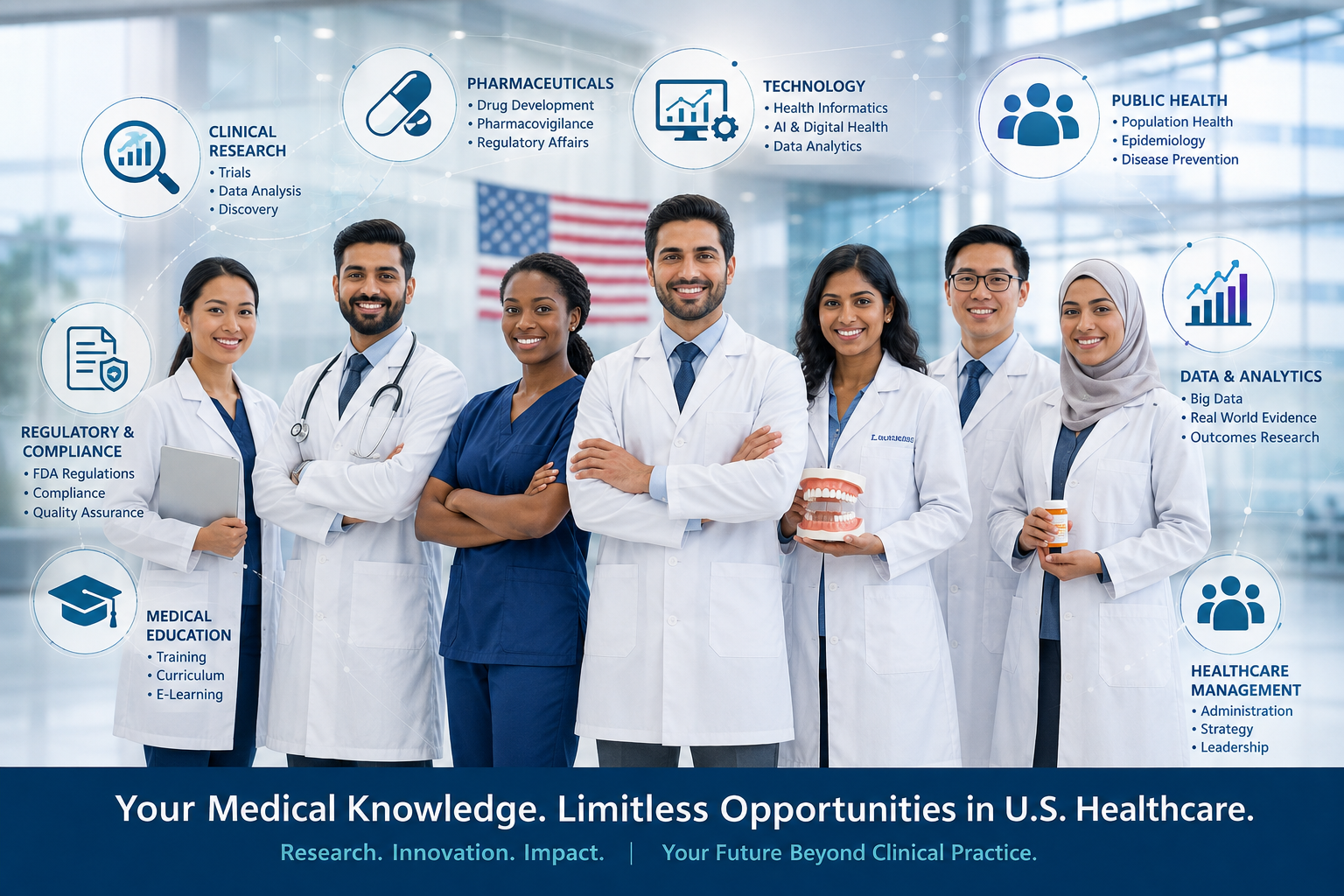
Do u know Non-Clinical Career Options for Foreign-Trained Doctors, Dentists, and Pharmacists in the U.S who do not want to pursue U.S. clinical licensure have more career options than they may realize. Their medical education does not necessarily have to be abandoned. In many cases, their healthcare knowledge can become a valuable advantage when combined with additional skills in research, business, technology, writing, public health, or healthcare operations.
The U.S. employment outlook makes this particularly interesting. According to the Bureau of Labor Statistics (BLS), healthcare and social assistance is projected to be the fastest-growing major industry sector through 2034, while employment in computer and mathematical occupations is projected to grow by 10.1% over the same period.
Source: Bureau of Labor Statistics, Industry and Occupational Employment Projections.
https://www.bls.gov/opub/mlr/2026/article/industry-and-occupational-employment
For internationally trained healthcare professionals, this creates an opportunity to combine their existing medical education with growing areas of the U.S. economy.
Why Foreign Medical Education Can Still Be Valuable Without U.S. Licensure
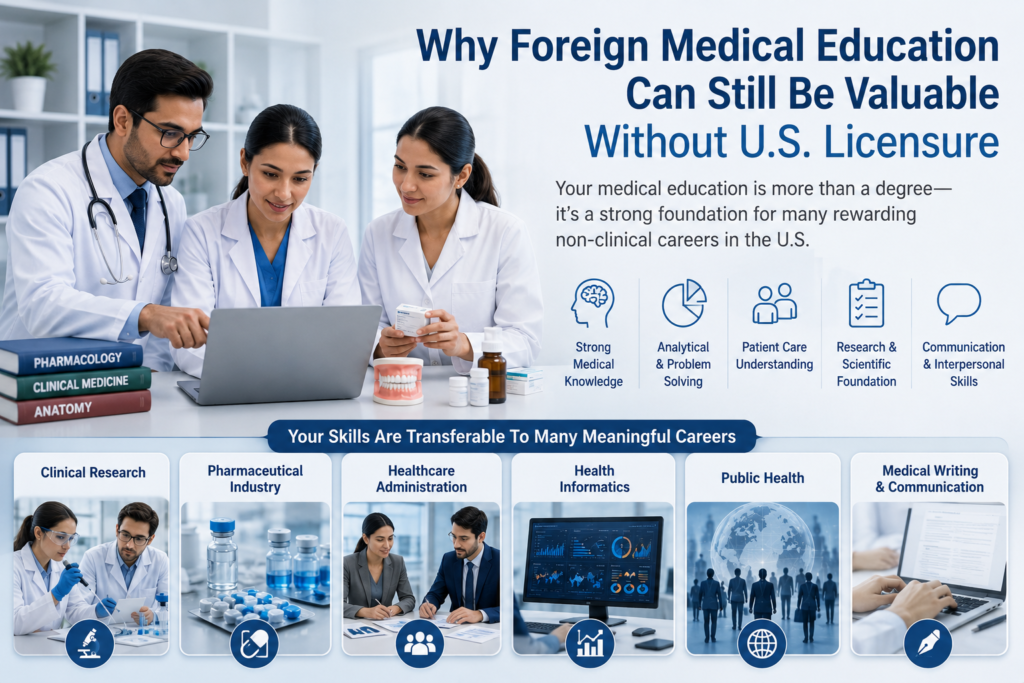
A foreign medical degree, dental degree, or pharmacy degree provides knowledge that can be useful far beyond direct patient care.Non-Clinical Career Options for Foreign-Trained Doctors, Dentists, and Pharmacists in the U.S.
Professionals may already have an understanding of medical terminology, anatomy, physiology, pharmacology, disease processes, clinical documentation, healthcare systems, research, and patient care.
Instead of starting an entirely new career from scratch, they can build on this foundation and develop an additional specialization.
Healthcare Knowledge Can Be Combined With Other Skills
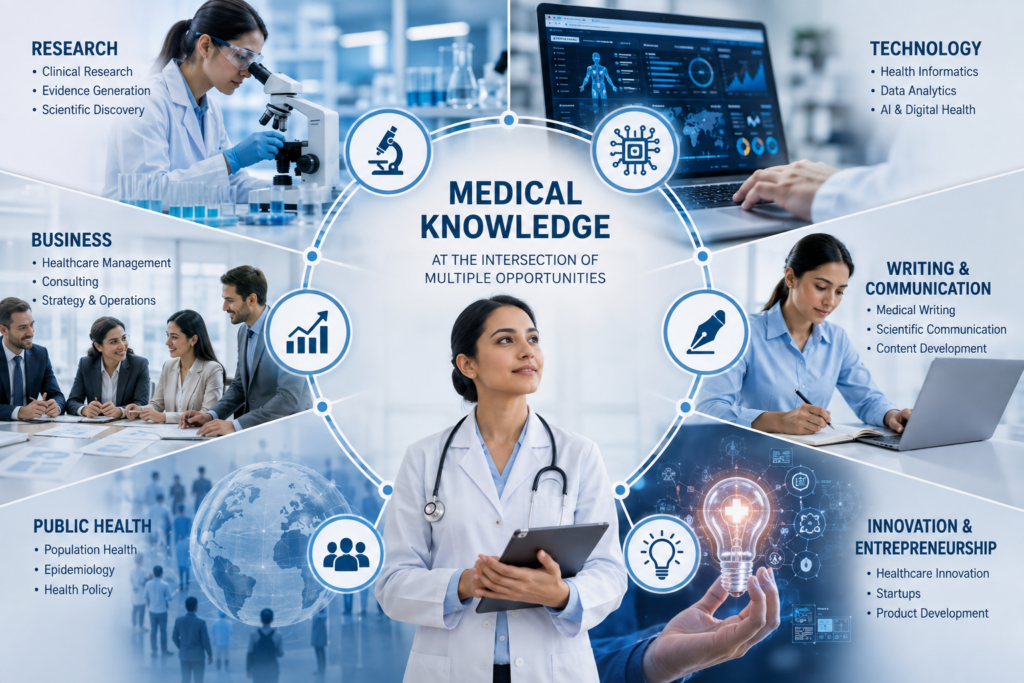
| Existing background | Additional skill | Potential career direction |
|---|---|---|
| Medicine | Clinical research | Clinical research |
| Medicine | Business | Healthcare consulting |
| Medicine | Technology | Health informatics |
| Medicine | Writing | Medical writing |
| Pharmacy | Drug safety | Pharmacovigilance |
| Pharmacy | Regulatory knowledge | Regulatory affairs |
| Dentistry | Public health | Public-health programs |
| Healthcare | Data analytics | Healthcare analytics |
| Healthcare | Education | Medical education |
| Healthcare | Technology | Digital health |
Clinical Practice and Non-Clinical Healthcare Careers Are Different
Not every healthcare career involves diagnosing patients, prescribing medication, performing procedures, or independently practicing a regulated profession.
Many positions in research, administration, pharmaceutical companies, biotechnology, healthcare technology, public health, education, and scientific communications are non-clinical.
However, job responsibilities and licensing requirements vary. Foreign-trained professionals should always review the requirements of the specific position and state before accepting a role.

13 Career Options for Foreign-Trained Doctors, Dentists, and Pharmacists
The following career paths can allow internationally trained healthcare professionals to use their existing medical knowledge while moving away from direct clinical practice.
1. Clinical Research Coordinator
Clinical research is one of the non-clinical career options for foreign-trained doctors who want to use their medical knowledge without pursuing U.S. clinical licensure.
Clinical Research Coordinators help manage clinical trials and research studies. They may coordinate study activities, maintain research documentation, communicate with investigators and study participants, and help research teams follow study protocols.
Why Medical Training Helps
A healthcare background can make it easier to understand clinical terminology, disease processes, research protocols, and communication between investigators and healthcare professionals.
Helpful preparation: Clinical research training, GCP knowledge, research experience, and familiarity with clinical-trial processes.
Career Progression
A Clinical Research Coordinator may eventually pursue opportunities such as Clinical Research Associate, research project management, clinical operations, or other clinical research positions.
2. Clinical Research Associate (CRA)
Clinical Research Associates work with pharmaceutical companies, biotechnology companies, and contract research organizations (CROs) to monitor clinical trials.
What CRAs Do
Depending on the position, responsibilities may include monitoring research sites, reviewing documentation, communicating with clinical research teams, and helping ensure that studies follow protocols and applicable requirements.
Helpful preparation: Good Clinical Practice (GCP), clinical research experience, and knowledge of clinical-trial operations.
3. Medical Affairs
Medical affairs is an important non-clinical career area within pharmaceutical and biotechnology companies.
Medical affairs professionals may contribute to scientific programs, medical communications, educational initiatives, clinical evidence, and collaboration with healthcare professionals.
Medical affairs offers another pathway for internationally trained healthcare professionals seeking non-clinical careers in the U.S.
Why It Can Suit International Medical Graduates
Doctors, dentists, and pharmacists often already possess a strong scientific foundation. Adding industry experience and knowledge of pharmaceutical or biotechnology operations can help them transition into medical-affairs positions.
Helpful preparation: Relevant experience, strong scientific communication skills, and sometimes an M.S. or other advanced degree, depending on the position.
4. Medical Science Liaison (MSL)
Medical Science Liaisons serve as scientific points of contact between life-sciences companies and healthcare professionals, researchers, and other scientific stakeholders.
Skills That Matter
MSL roles generally require strong scientific knowledge and communication skills. Professionals may need to understand clinical research, interpret scientific information, and communicate complex medical concepts clearly.
Helpful preparation: Strong scientific background, presentation skills, clinical or research experience, and relevant industry knowledge.
5. Medical Writer
Medical writers create scientific and healthcare content for professional, educational, patient, research, and commercial audiences.
Medical writing can be a practical non-clinical career option for foreign-trained doctors, dentists, and pharmacists with strong communication skills.
Types of Medical Writing
A medical writer may work on:
- Medical education materials
- Patient education content
- Scientific communications
- Healthcare articles
- Clinical research documents
- Regulatory documents
- Pharmaceutical communications
- Medical websites
How to Enter Medical Writing
A medical background provides subject-matter knowledge, but strong writing and editing skills are equally important.
Creating a portfolio of high-quality medical and scientific writing samples can help demonstrate these abilities to potential employers.
6. Healthcare Consultant
Healthcare consultants advise healthcare organizations and life-sciences companies on business, operations, strategy, technology, and organizational challenges.
Potential Employers
Healthcare consultants may work with:
- Hospitals
- Healthcare systems
- Pharmaceutical companies
- Biotechnology companies
- Medical-device organizations
- Health-tech companies
- Insurance organizations
- Consulting firms
Education and Skills
An MBA, MHA, MPH, or related graduate degree can be useful for some positions, although requirements differ.
Foreign-trained healthcare professionals may have an advantage in areas where understanding both healthcare and business is important.
7. Healthcare Administration
Healthcare administration focuses on managing healthcare organizations and their operations rather than providing direct clinical care.
Areas of Healthcare Administration
Professionals may work in:
- Hospital operations
- Healthcare strategy
- Quality improvement
- Program management
- Patient services
- Healthcare management
- Administrative operations
Additional Education
An MHA or MBA can be useful for professionals who want to progress into management and leadership positions.
8. Pharmacovigilance and Drug Safety
Pharmacovigilance focuses on monitoring and evaluating medication safety and adverse drug events.
This can be a particularly relevant field for foreign-trained pharmacists because their education often includes pharmacology, drug interactions, therapeutic effects, and adverse effects.
What Professionals May Do
Depending on the position, responsibilities can include reviewing safety information, evaluating adverse-event reports, maintaining safety documentation, and supporting drug-safety activities.
Helpful preparation: Pharmacovigilance training, clinical research knowledge, and familiarity with relevant regulatory requirements.
9. Regulatory Affairs
Regulatory affairs professionals help pharmaceutical, biotechnology, and medical-device companies navigate regulatory requirements.
What Regulatory Affairs Involves
Professionals may contribute to:
- Regulatory submissions
- Product approvals
- Compliance activities
- Regulatory documentation
- Communications with regulatory organizations
- Maintaining regulatory records
Building Regulatory Expertise
Specialized regulatory-affairs education or training can help internationally trained healthcare professionals understand the U.S. regulatory environment.
10. Health Informatics
Health informatics combines healthcare with information technology, data, and digital systems.
Healthcare organizations generate enormous amounts of clinical and administrative information. Professionals with both healthcare knowledge and technology skills can help organizations manage and use this information effectively.
Potential Areas
Health informatics professionals may work with:
- Electronic health records
- Clinical information systems
- Healthcare data
- Health analytics
- Data management
- Clinical informatics
- Digital-health systems
Skills to Consider
Depending on the target position, useful skills may include healthcare databases, data analytics, information systems, statistics, and health-informatics concepts.
A master’s degree or professional certificate can be helpful for some roles.
11. Medical Coding and Clinical Documentation
Medical coding and clinical documentation involve organizing and translating healthcare information for administrative, billing, reporting, and documentation purposes.
Why Medical Knowledge Helps
Foreign-trained healthcare professionals may already be familiar with:
- Medical terminology
- Anatomy
- Diagnoses
- Procedures
- Clinical documentation
- Disease terminology
Additional coding education and professional certification can help candidates transition into this field.
12. Public Health
Public health focuses on improving health at the population level rather than treating individual patients.
Potential Public Health Areas
Foreign-trained healthcare professionals can explore areas such as:
- Epidemiology
- Community health
- Health education
- Health programs
- Global health
- Health policy
- Public-health research
Is an MPH Useful?
A Master of Public Health (MPH) can be useful for many public-health career paths, particularly for professionals seeking positions involving program management, epidemiology, research, or health policy.
13. Medical Education and Healthcare Technology
Medical education and healthcare technology offer two additional paths for professionals who want to remain connected to healthcare.
Medical Education
Medical education professionals may help develop educational programs, training materials, curricula, assessments, and continuing-education resources.
Teaching experience can be helpful, while requirements vary by employer.
Healthcare Technology
Healthcare technology combines healthcare knowledge with software, data, artificial intelligence, digital platforms, and information systems.
Foreign-trained healthcare professionals may find opportunities with digital-health and AI companies where medical knowledge is valuable for product development, content, research, implementation, or clinical workflows.
Healthcare Technology and the Growing Role of Data
Healthcare organizations—including hospitals, pharmacies, insurers, pharmaceutical companies, and health-tech companies—handle enormous amounts of sensitive healthcare information.
This makes professionals who understand both healthcare and technology increasingly valuable.
Healthcare + Technology Is a Powerful Combination
A healthcare professional does not necessarily need to become a software engineer to enter healthcare technology.
Developing skills in areas such as data analytics, health informatics, digital health, artificial intelligence concepts, or information systems can complement an existing medical background.
Examples of Skill Combinations
| Medical background | Technology/business skill | Possible direction |
|---|---|---|
| Medicine | Data analytics | Healthcare analytics |
| Medicine | AI concepts | Healthcare AI |
| Pharmacy | Technology | Digital pharmacy |
| Pharmacy | Data | Medication analytics |
| Dentistry | Digital health | Oral-health technology |
| Healthcare | Information systems | Health informatics |
| Healthcare | Product management | Health-tech |
| Healthcare | Business | Healthcare consulting |
Comparing the 13 Career Options
| Career | Medical knowledge used | Additional preparation |
|---|---|---|
| Clinical Research Coordinator | High | Research/GCP training |
| Clinical Research Associate | High | GCP + research experience |
| Medical Affairs | High | Industry experience; advanced degree may help |
| Medical Science Liaison | High | Scientific communication + relevant experience |
| Medical Writer | High | Writing/editing portfolio |
| Healthcare Consultant | Medium–High | MBA/MHA may help |
| Healthcare Administration | Medium–High | MHA/MBA may help |
| Pharmacovigilance | Very high for pharmacists | Drug-safety training |
| Regulatory Affairs | High | Regulatory training |
| Health Informatics | High | Informatics/data training |
| Medical Coding | High | Coding education/certification |
| Public Health | High | MPH often useful |
| Medical Education/Health Technology | High | Teaching or technology skills |
Which Career Path Is Best for You?
There is no single career that is best for every foreign-trained healthcare professional. The right choice depends on your previous education, professional experience, interests, technical skills, and willingness to pursue additional education.
If You Are a Foreign-Trained Doctor
Physicians may consider clinical research, medical affairs, MSL roles, medical writing, healthcare consulting, public health, healthcare administration, health informatics, and healthcare technology.
A Useful Strategy
Rather than completely changing fields, consider combining medicine with another specialization:
Medicine + research = clinical research
Medicine + business = healthcare consulting
Medicine + technology = health informatics
Medicine + writing = medical communications
If You Are a Foreign-Trained Dentist
Dentists can explore clinical research, public health, medical or dental writing, healthcare administration, medical education, consulting, and healthcare technology.
Dentistry + Public Health
Combining dental knowledge with public-health training can create opportunities involving population oral health, community programs, health education, and research.
If You Are a Foreign-Trained Pharmacist
Pharmacists may find particularly relevant opportunities in pharmacovigilance, drug safety, regulatory affairs, clinical research, medical affairs, medical writing, pharmaceutical companies, and healthcare technology.
Pharmacy + Industry
Pharmacy knowledge can remain valuable even when the role does not involve dispensing medication. Pharmaceutical and biotechnology organizations need professionals who understand medicines, clinical evidence, safety, and healthcare.
How to Choose a Non-Clinical Career
Before selecting a career path, consider several factors.
1. Start With Your Existing Strengths
Think about what you already know well. A pharmacist with strong pharmacology knowledge may naturally explore pharmacovigilance, while a physician with research experience may find clinical research a more direct transition.
2. Identify the Skill You Need to Add
Your existing healthcare education is one part of your professional profile. The next step may be developing a complementary skill.
Examples
- Research
- Data analytics
- Medical writing
- Business
- Regulatory knowledge
- Technology
- Public health
- Project management
3. Review Actual Job Descriptions
Career titles can vary considerably between employers. Reviewing current job postings can help you identify recurring requirements and determine which skills or certifications are most frequently requested.
4. Build Experience Gradually
A certificate, portfolio, internship, research project, volunteer experience, or entry-level position can sometimes provide a bridge between previous healthcare experience and a new career.

Key Takeaway
Foreign-trained doctors, dentists, and pharmacists do not necessarily have to choose between pursuing U.S. clinical licensure and abandoning healthcare altogether.
There is a broad middle ground.
Their existing medical education can provide a foundation for careers in clinical research, medical affairs, medical writing, healthcare consulting, administration, pharmacovigilance, regulatory affairs, health informatics, medical coding, public health, medical education, and healthcare technology.
The most valuable strategy may be to combine existing healthcare expertise with a second, in-demand skill.
Healthcare + research.
Healthcare + technology.
Healthcare + data.
Healthcare + business.
Healthcare + communication.
For many internationally trained professionals, the goal is not to start over—it is to build on what they already know and redirect it toward a new opportunity.
Frequently Asked Questions
Can a foreign-trained doctor work in the U.S. without completing U.S. medical licensure?
Yes. There are many non-clinical healthcare and life-sciences positions that do not involve practicing medicine. However, activities that legally require a professional license still require the appropriate U.S. credentials.
Can foreign-trained dentists find healthcare jobs without a U.S. dental license?
Yes. Depending on the position, dental knowledge can be useful in research, public health, education, healthcare administration, writing, consulting, and healthcare technology.
What are some good careers for foreign-trained pharmacists?
Potential options include pharmacovigilance, drug safety, regulatory affairs, clinical research, medical affairs, medical writing, healthcare technology, and pharmaceutical-industry roles.
Do I need a master’s degree to work in these careers?
Not always. Some jobs may value experience, specialized training, certifications, technical skills, or a strong portfolio instead. Requirements vary by career and employer.
Is clinical research a good option for foreign-trained medical professionals?
It can be. A healthcare background can provide familiarity with medical terminology, disease processes, clinical environments, and scientific concepts. Additional research training and experience can strengthen a candidate’s qualifications.
Is health informatics suitable for someone with a medical background?
Yes. Health informatics is specifically focused on the intersection of healthcare and information. Professionals can add skills in data analytics, information systems, databases, or health technology to their existing healthcare knowledge.
Can a foreign medical degree help with a career in pharmaceutical companies?
Yes. Pharmaceutical and biotechnology organizations employ professionals in areas such as clinical research, medical affairs, pharmacovigilance, regulatory affairs, medical communications, and other scientific functions.
What is the biggest advantage of a foreign medical background?
It gives professionals a foundation in healthcare that can be combined with another specialization. Instead of completely starting over, they can build a career around a combination such as healthcare and technology, healthcare and research, or healthcare and business.
What should I do first if I want to change careers?
Start by identifying two or three career paths that match your existing background. Then review current job descriptions to determine the most common education, experience, certification, and technical requirements. From there, choose targeted training rather than pursuing education without a specific career goal.



Leave a Reply