

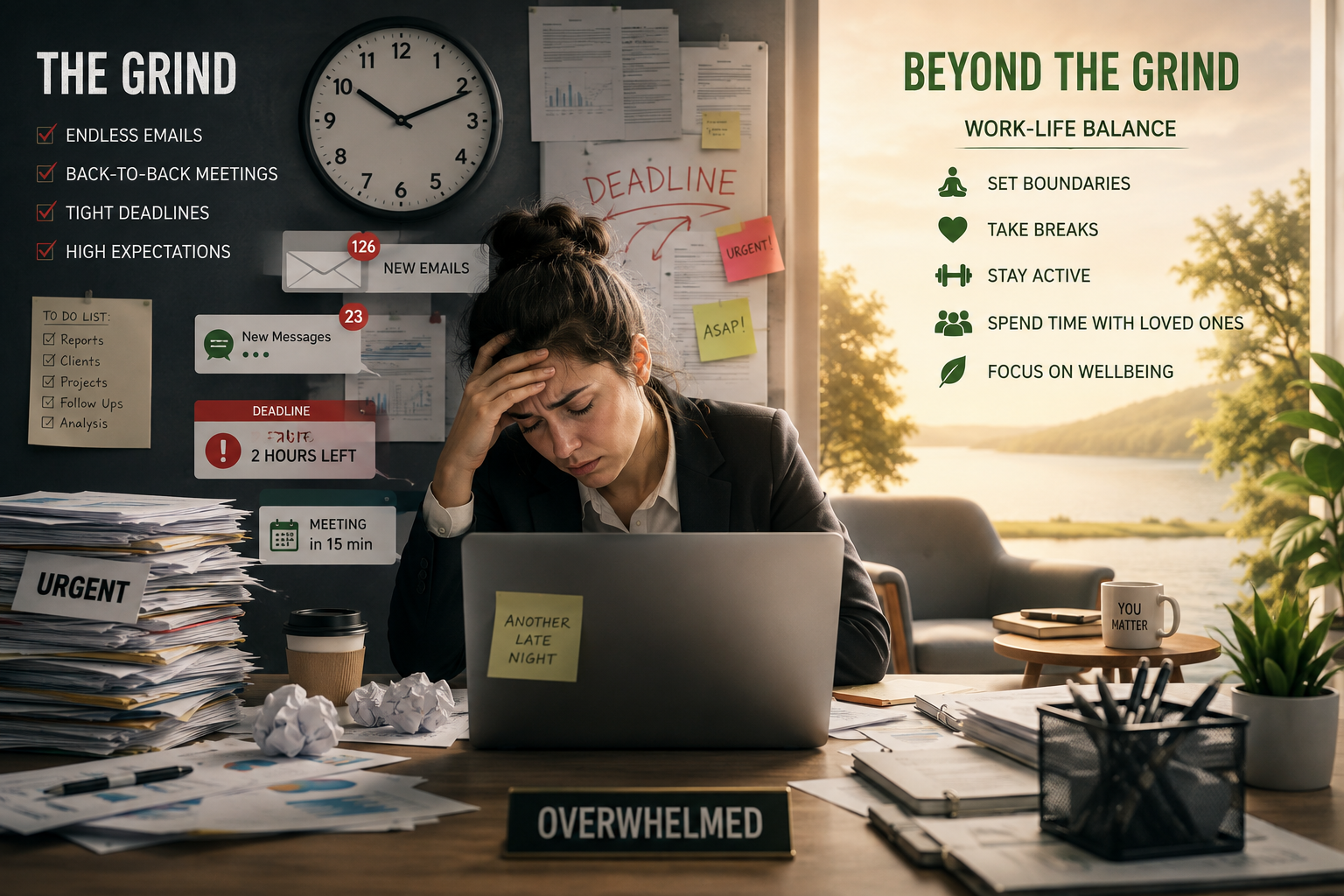
Workplace burnout rarely happens overnight. It often develops gradually, beginning with ambition and dedication, progressing into chronic overwork, and eventually leading to emotional exhaustion, mental fatigue, and physical stress.
For many high-performing professionals, burnout can be difficult to recognize. What feels like a temporary productivity problem may actually be a warning that your physical and mental resources are running low.
As a career coach, I often see professionals respond to workplace stress by pushing themselves even harder. But when your body and mind are asking for recovery, working longer hours is rarely the best solution.
True professional growth should not require sacrificing your health.
The good news is that recognizing the early signs of burnout can help you make changes before exhaustion becomes deeply disruptive to your work and personal life.
What Is Workplace Burnout?
Workplace burnout is a state associated with chronic workplace stress that has not been successfully managed. The World Health Organization (WHO) describes burnout in the ICD-11 as an occupational phenomenon, rather than a medical condition.
Burnout is commonly characterized by three major dimensions:
- Emotional and physical exhaustion
- Increased mental distance, cynicism, or negativity toward work
- Reduced professional effectiveness
Burnout can affect employees, managers, entrepreneurs, freelancers, healthcare professionals, teachers, and other people working under sustained pressure.
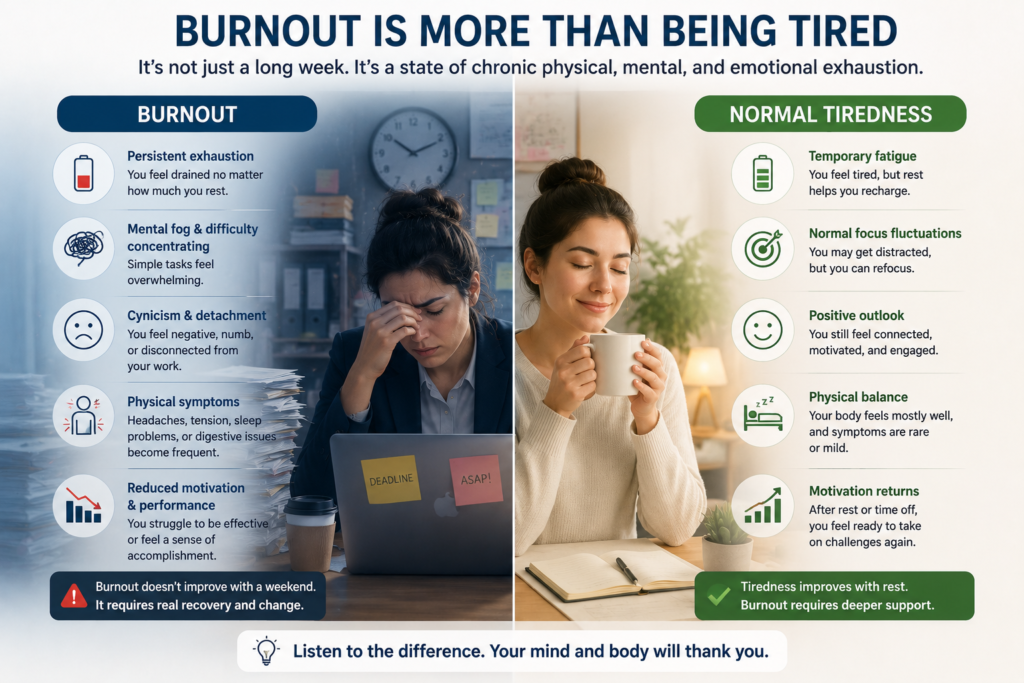
Burnout Is More Than Being Tired
A stressful week does not necessarily mean you are experiencing burnout.
Normal work fatigue may improve after adequate sleep, time away from work, or a relaxing weekend. Professional burnout, however, can feel more persistent and may affect motivation, concentration, emotional wellbeing, and your ability to perform everyday tasks.
| Normal Work Stress | Workplace Burnout |
|---|---|
| Usually temporary | Can become persistent |
| You may feel tired but recover | Recovery may feel increasingly difficult |
| Motivation generally returns | Motivation may decline significantly |
| Stress is linked to specific situations | Exhaustion may become more constant |
| Time away can help | Time away may not feel sufficient |
| You remain relatively engaged | Cynicism or emotional detachment may develop |
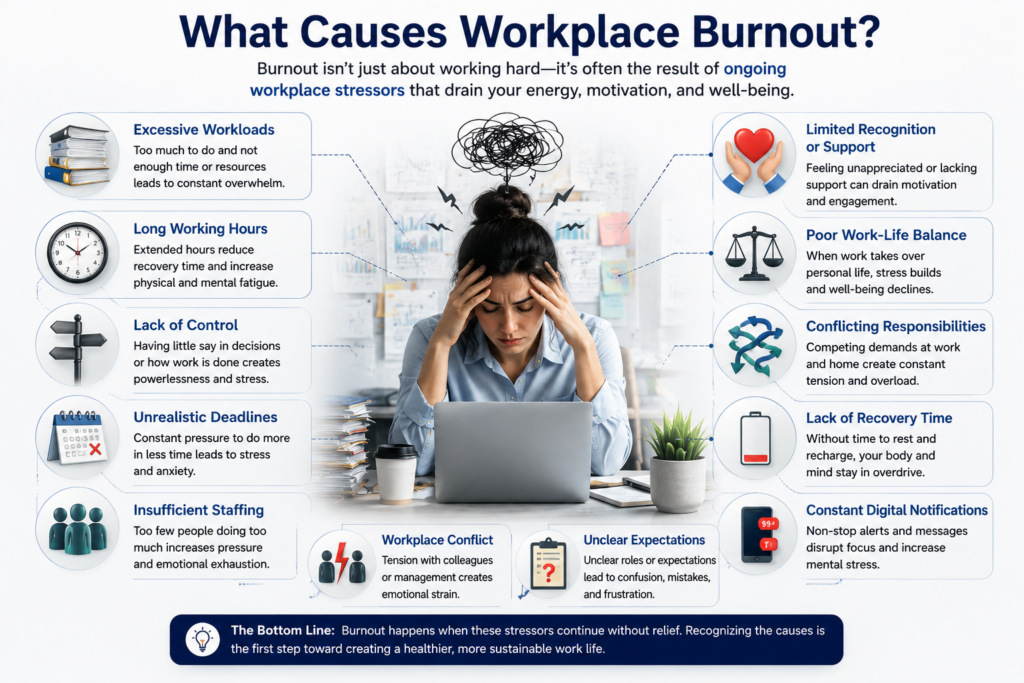
What Causes Workplace Burnout?
Burnout can have multiple contributing factors. It is not simply a result of poor time management or a lack of personal discipline.
Common workplace contributors include:
- Excessive workloads
- Long working hours
- Lack of control over work
- Unrealistic deadlines
- Insufficient staffing
- Limited recognition or support
- Poor work-life balance
- Conflicting responsibilities
- Lack of recovery time
- Constant digital notifications
- Workplace conflict
- Unclear expectations
The Overwork Cycle
One of the most common patterns behind employee burnout looks like this:
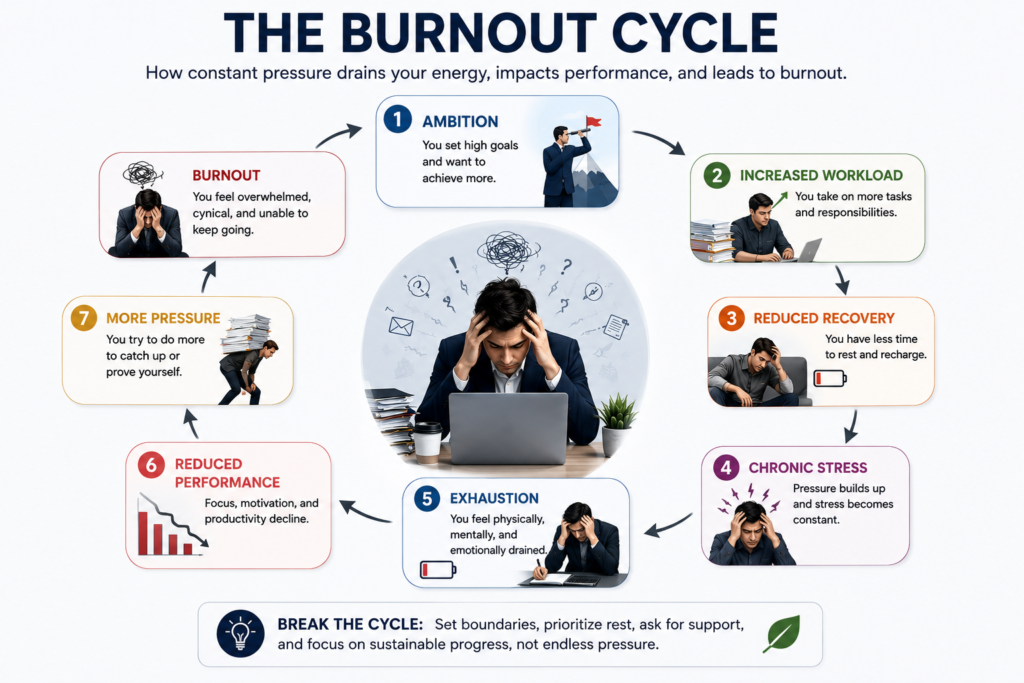
Ambition → Increased workload → Reduced recovery → Chronic stress → Exhaustion → Reduced performance → More pressure → Burnout
The problem is that many ambitious professionals respond to declining productivity by increasing their workload.
That can create a cycle in which the solution to feeling overwhelmed becomes even more work.
Recognizing the Early Signs of Burnout
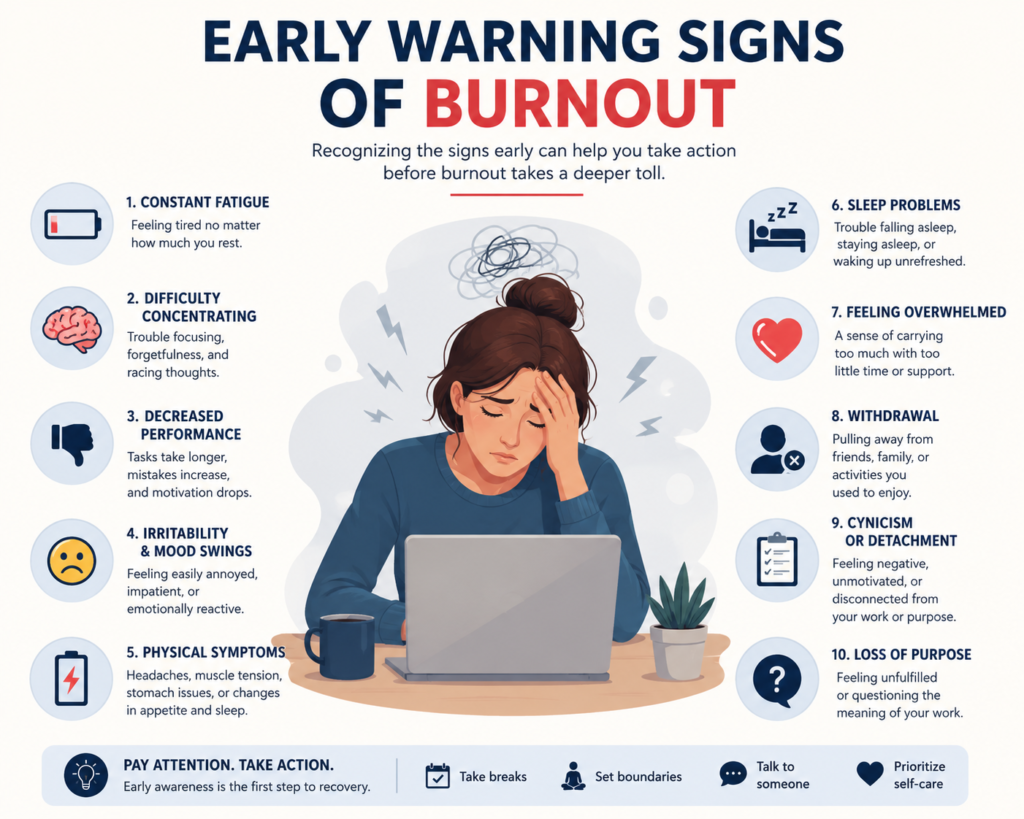
Identifying burnout symptoms early is one of the most important parts of burnout prevention.
The signs can appear emotionally, cognitively, physically, and behaviorally.
1. Emotional Exhaustion
Emotional exhaustion is one of the most recognizable signs of workplace burnout.
You may notice that:
- Work feels overwhelming even before the day begins.
- Small problems trigger unusually strong reactions.
- You feel emotionally drained after ordinary workdays.
- You have less patience with coworkers or clients.
- Activities that previously motivated you no longer feel rewarding.
Ask Yourself
“Am I simply tired from a busy period, or do I feel consistently drained by work?”
If exhaustion continues despite reasonable opportunities for rest, it may be worth examining your workload and recovery habits.
2. Emotional Detachment and Cynicism
Another important sign of burnout is becoming increasingly detached from your work.
You might begin thinking:
- “It doesn’t matter anyway.”
- “I don’t care anymore.”
- “I just want to get through the day.”
- “Everyone is making this harder than it needs to be.”
You may also become more cynical toward colleagues, management, customers, or the organization.
This emotional distancing can serve as a warning that your capacity is being stretched for too long.
3. Cognitive Fatigue and Brain Fog
Burnout can also affect how you think and work.
Cognitive fatigue may show up as:
- Difficulty concentrating
- Forgetfulness
- Brain fog
- Decision paralysis
- Reduced creativity
- Difficulty solving problems
- Taking longer to complete familiar tasks
- Frequently switching between tasks without finishing them
Why Cognitive Recovery Matters
Your brain needs periods of recovery just as your body does.
Constant meetings, notifications, multitasking, and uninterrupted screen time can make it difficult to maintain sustained attention.
This is why energy management can be just as important as traditional time management.
4. Physical Signs of Workplace Stress
Workplace stress can also be accompanied by physical symptoms.
Some people experiencing prolonged stress may notice:
- Headaches
- Muscle tension
- Sleep difficulties
- Digestive discomfort
- Persistent fatigue
- Changes in appetite
- Difficulty relaxing after work
These symptoms can have many possible causes and should not automatically be attributed to burnout.
Persistent, severe, or unexplained physical symptoms should be discussed with a qualified healthcare professional.
Workplace Burnout Prevention Checklist
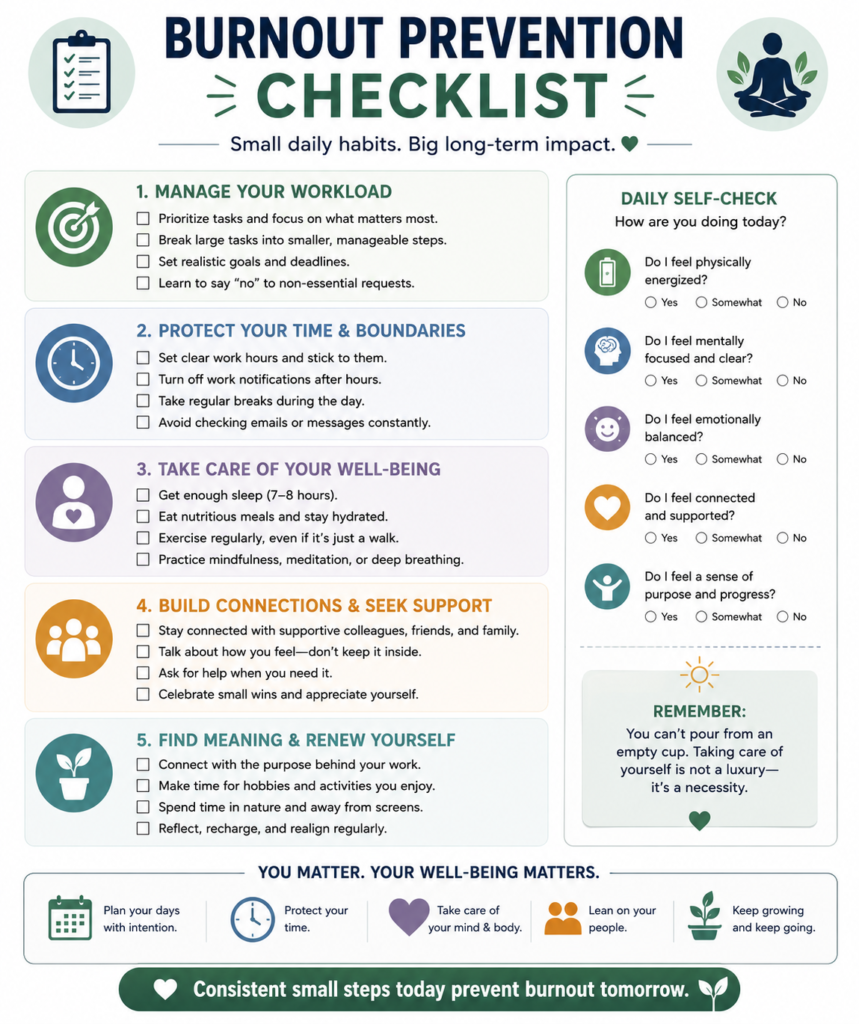
Use this simple checklist to evaluate your current work routine.
| Question | Yes | No |
|---|---|---|
| Do I regularly work beyond my planned hours? | ☐ | ☐ |
| Do I check work messages outside working hours? | ☐ | ☐ |
| Do I regularly skip or shorten lunch breaks? | ☐ | ☐ |
| Do I struggle to mentally disconnect from work? | ☐ | ☐ |
| Do I frequently feel emotionally exhausted? | ☐ | ☐ |
| Am I having difficulty concentrating? | ☐ | ☐ |
| Have I become increasingly cynical about my work? | ☐ | ☐ |
| Do I have enough time for sleep and recovery? | ☐ | ☐ |
| Can I say no or negotiate competing priorities? | ☐ | ☐ |
| Do I regularly take short breaks during the day? | ☐ | ☐ |
If many of these answers concern you, consider reviewing your workload, boundaries, recovery habits, and available workplace support.
This checklist is not a diagnostic test for burnout.
Burnout vs. Stress: What’s the Difference?
Although workplace stress and burnout are related, they are not identical.
| Feature | Workplace Stress | Burnout |
|---|---|---|
| Duration | May be short-term or situational | Often associated with prolonged workplace stress |
| Energy | You may feel anxious or overwhelmed | Deep exhaustion can become prominent |
| Motivation | Often remains present | Can decrease substantially |
| Attitude toward work | Frustration may be situation-specific | Cynicism or detachment may develop |
| Recovery | Rest may provide noticeable relief | Recovery may become more difficult |
| Performance | Can fluctuate | Reduced effectiveness may become more noticeable |
The distinction is important because the solution to a stressful deadline may simply be recovery and workload adjustment, while persistent burnout may require broader changes.
How Employers Can Help Prevent Employee Burnout
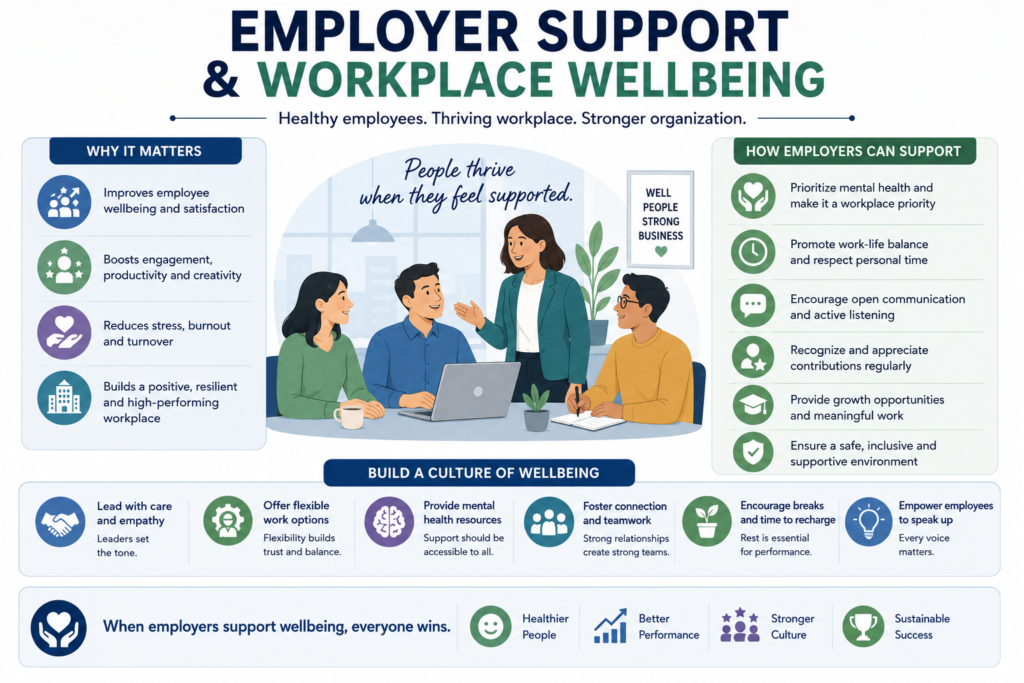
Burnout prevention is not only an individual responsibility.
Organizations also influence workload, staffing, expectations, autonomy, communication, and workplace culture.
Employers Can Support Workplace Wellbeing By:
1. Setting Realistic Workloads
Employees cannot sustainably compensate for chronic understaffing by working longer hours indefinitely.
2. Encouraging Meaningful Breaks
Breaks should be treated as part of sustainable productivity rather than as a sign of poor commitment.
3. Creating Clear Priorities
When everything is urgent, employees may struggle to determine where their attention should go.
4. Supporting Flexible Work Practices
Where appropriate, flexibility can help employees manage responsibilities and protect recovery time.
5. Training Managers to Recognize Burnout
Managers should understand the difference between temporary stress and signs that an employee may be struggling with prolonged workload pressure.
A Simple Daily Routine for Burnout Prevention
You don’t need to redesign your entire life in one day.
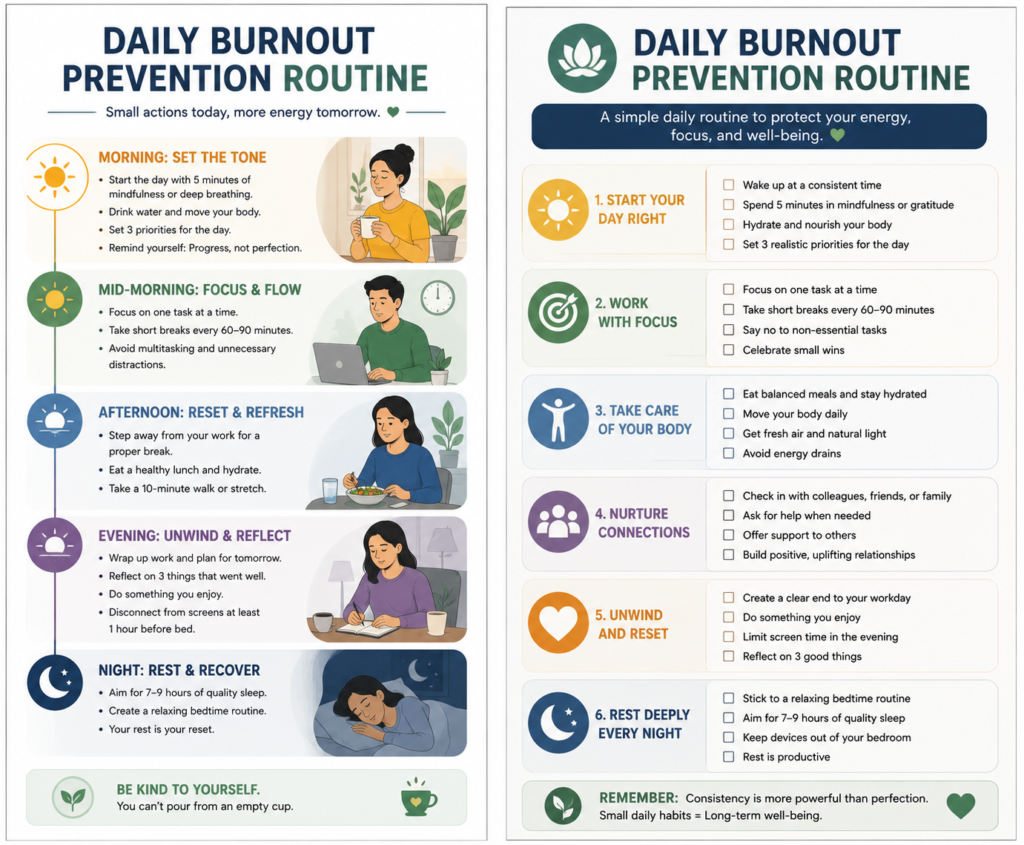
Start with a simple routine.
| Time | Burnout Prevention Habit |
|---|---|
| Morning | Complete your highest-priority task |
| Mid-morning | Take a short movement or screen break |
| Midday | Protect your lunch break |
| Afternoon | Batch administrative tasks |
| Between meetings | Take 2–5 minutes to reset |
| End of workday | Review unfinished priorities |
| Evening | Disconnect from work notifications |
| Before bed | Create a calming, screen-light routine |
Small, consistent changes can be easier to maintain than dramatic productivity overhauls.
When Should You Seek Professional Support?
Burnout can overlap with other physical or psychological conditions, so it is important not to self-diagnose based solely on an online article.
Consider speaking with a qualified healthcare or mental-health professional if you are experiencing persistent:
- Exhaustion
- Sleep problems
- Anxiety
- Low mood
- Difficulty functioning at work or home
- Significant changes in appetite
- Physical symptoms that concern you
If symptoms are severe or you feel unsafe, seek professional help promptly.
Frequently Asked Questions About Workplace Burnout
What are the main signs of workplace burnout?
Common signs can include persistent exhaustion, increased cynicism or detachment from work, difficulty concentrating, and reduced professional effectiveness. Physical symptoms such as headaches, muscle tension, or sleep difficulties may also occur but can have many causes.
Can workplace burnout be prevented?
Yes, burnout prevention can involve managing workload, establishing realistic boundaries, taking regular recovery breaks, improving workplace conditions, and addressing chronic sources of stress.
Is burnout the same as stress?
No. Stress and burnout are related but different. Stress can be temporary and situation-specific, whereas burnout is associated with prolonged workplace stress and may involve exhaustion, cynicism, and reduced effectiveness.
How can I prevent employee burnout on my team?
Managers can help by setting realistic priorities, monitoring workloads, encouraging breaks, providing support, clarifying expectations, and creating an environment where employees can communicate about capacity.
Does taking a vacation cure burnout?
A vacation can provide valuable recovery time, but it may not address the underlying causes of burnout. If excessive workload, unrealistic expectations, or poor workplace conditions remain unchanged, symptoms may return.
What is the difference between time management and energy management?
Time management focuses on how you allocate available hours. Energy management considers when you are mentally and physically best equipped for different types of work and recovery.
How long does workplace burnout last?
There is no single timeline. Recovery depends on factors such as the severity and duration of the problem, the individual’s circumstances, available support, and whether the underlying workplace stressors are addressed.
Can burnout affect productivity?
Yes. Burnout can be associated with difficulty concentrating, reduced motivation, fatigue, and reduced professional effectiveness, potentially making work take longer and feel more difficult.
The Bottom Line: Sustainable Success Requires Recovery
Workplace burnout is not a badge of professional success.
Working longer, answering messages late at night, skipping breaks, and constantly saying yes may create the appearance of productivity—but they are not necessarily sustainable strategies for long-term career growth.
The most effective approach to burnout prevention is not simply doing less. It is learning to work in a way that respects your capacity.
Build hard guardrails.
Audit your commitments.
Manage your energy.
Take micro-rest breaks.
Ask for support when you need it.
Protecting your wellbeing is not a distraction from your career goals—it is part of building a career that you can sustain.





Leave a Reply