

Diabetic treatment research is exploring how metformin, a widely used medicine for type 2 diabetes, may influence blood sugar through the brain. Scientists have identified a signaling pathway involving Rap1 that helps explain the drug’s effects in mice. www.bcm.edu
The discovery raises questions about how medicines interact with the body’s glucose-control systems. It also highlights why research findings need careful interpretation before they become treatment recommendations.
For patients, the practical distinction is straightforward: learning more about how a medicine works does not automatically change how it should be taken.
This article explains the findings, their limitations, and the questions researchers would need to answer before applying them to human care.
Diabetic Treatment and Metformin: Understanding the Basics
Metformin belongs to a group of medicines called biguanides. It helps manage type 2 diabetes by reducing glucose production in the liver and improving the body’s response to insulin. It may be prescribed alone or with other diabetes medicines. medlineplus.gov
Understanding diabetic treatment involves separating three questions:
- What does the medicine do?
- How does it produce that effect?
- How well does it work for an individual patient?
A medicine can have an established clinical role while researchers continue investigating its mechanisms.
| Term | Meaning for readers |
|---|---|
| Blood glucose | Sugar circulating in the bloodstream |
| Mechanism of action | The biological process through which a medicine produces an effect |
| Treatment response | How a person’s condition changes during treatment |
| Experimental finding | A result observed under specific research conditions |
| Clinical recommendation | Guidance supported by evidence relevant to patient care |
Diabetic Treatment Research: What Scientists Investigated
The researchers examined Rap1 signaling in the ventromedial hypothalamus, a brain region involved in metabolic regulation. Their experiments included genetically modified mice and recordings from brain tissue.
Metformin increased the electrical activity of certain SF1 neurons when Rap1 was present. That response was absent in the tested neurons lacking Rap1. Very small amounts of metformin delivered directly into mouse brains also reduced blood glucose. www.bcm.edu
What Is Rap1, and How Is It Connected to Diabetic Treatment?
Rap1, short for Ras-related protein 1, is a signaling protein that acts like a molecular switch inside cells. It helps relay messages that influence how cells respond.
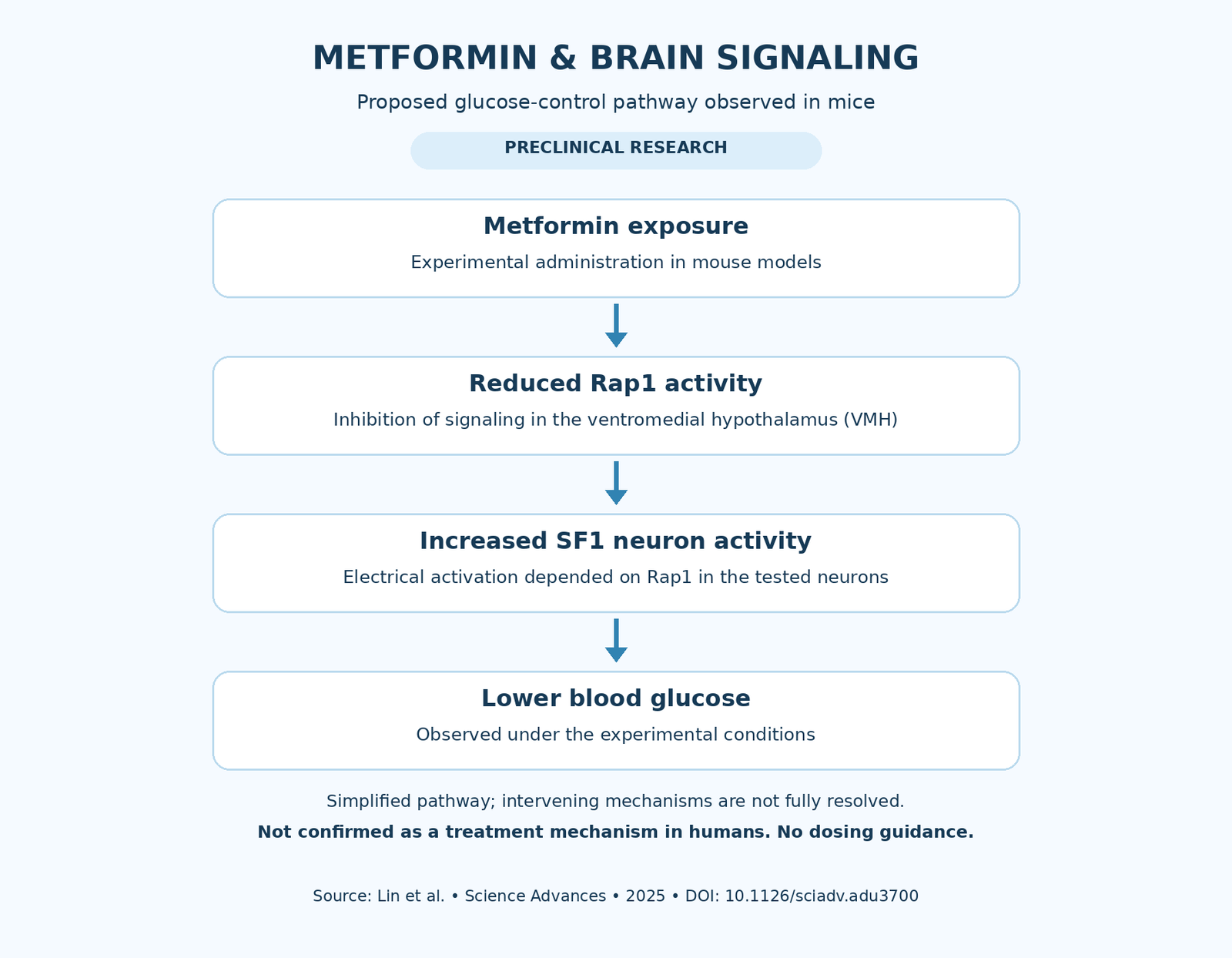
In this mouse study, researchers investigated Rap1 in the ventromedial hypothalamus, a brain region involved in blood sugar regulation. Metformin reduced Rap1 activity while increasing the electrical activity of certain neurons called SF1 neurons.
Importantly, metformin inhibited Rap1; it did not activate it. When Rap1 was absent from the tested neurons, metformin no longer increased their activity. This supports a role for Rap1 signaling in the response, but does not establish how the mechanism contributes to diabetic treatment in humans. pmc.ncbi.nlm.nih.gov
Diabetic Treatment Findings: Metformin Inhibited Rap1
An important detail is that metformin suppressed Rap1 activity, rather than activating the protein. Neuronal activation was a separate response.
The study also found that keeping brain Rap1 persistently active blocked metformin’s glucose-lowering effect in the tested model. At higher experimental doses, some effects could bypass the requirement for brain Rap1. pmc.ncbi.nlm.nih.gov
These details make the research more specific than a headline suggesting that metformin simply “switches on the brain.”
What This Means for Diabetic Treatment Research
The findings identify a pathway worth investigating. They do not establish a new treatment protocol for people.
| Finding or question | Appropriate interpretation |
|---|---|
| A brain pathway responded to metformin | A possible mechanism deserves further investigation |
| Genetic changes altered the drug response | The pathway mattered under the tested conditions |
| Direct brain delivery used tiny quantities | This does not establish an equivalent oral dose |
| The experiments involved mice | Human relevance needs separate validation |
The underlying paper was published online on July 30, 2025, in Science Advances. It was not a human clinical trial. pubmed.ncbi.nlm.nih.gov
Why a Mechanism Is Not a Treatment Recommendation
A mechanism explains a biological process. A treatment recommendation must consider whether an intervention benefits people, how it compares with alternatives, and whether its risks are acceptable.
For example, a change in cell activity does not by itself demonstrate better long-term glucose control or fewer diabetes complications.
When reading diabetic treatment news, ask:
- What was studied? Cells, animals, or people?
- What was measured? A molecular signal, glucose levels, symptoms, or long-term outcomes?
- What does the evidence support? More research or a change in care?
These questions help readers understand progress without overstating its practical implications.
How Metformin Fits Into Everyday Diabetes Care
Metformin helps control diabetes, but it does not cure it. Treatment also involves an individualized plan for food choices, physical activity, monitoring, and follow-up. medlineplus.gov

The most useful diabetic treatment plan is one that can be reviewed against a patient’s results, needs, and ability to follow it.
| Topic to discuss with a clinician | Useful question |
|---|---|
| Treatment effectiveness | How will we assess whether my current medicine is working? |
| Tolerability | What should I do if side effects interfere with taking it? |
| Monitoring | Which checks do I need, and when? |
| Treatment review | What would lead us to adjust my care plan? |
Metformin has a low risk of causing low blood sugar when used alone. Diarrhea is a common side effect, and kidney function is an important consideration during treatment. medlineplus.gov
Should Patients Change Their Metformin Dose?
No dose change should be made on the basis of this research. Direct drug delivery into an animal’s brain cannot be translated into a recommendation for taking tablets.
Take metformin as prescribed, and discuss any proposed changes with your healthcare professional. MedlinePlus advises patients not to stop metformin without speaking with their doctor. medlineplus.gov
Could Brain Signaling Influence Future Diabetic Treatment?

Baylor’s researchers described the pathway as a possible direction for developing future therapies. This is a research opportunity rather than an available treatment arising from the discovery. www.bcm.edu
Before any proposed approach could become routine care, researchers would need answers to practical questions.
| Research priority | Why it matters |
|---|---|
| Human validation | Establish whether the mechanism contributes meaningfully in people |
| Selective targeting | Determine whether an intervention can reach the intended cells |
| Safety | Assess unwanted effects and longer-term risks |
| Clinical benefit | Measure outcomes that matter to patients |
| Comparison with existing care | Determine whether the approach offers a useful advantage |
These are criteria for assessing future evidence, rather than predictions that a particular therapy will succeed.
Does This Research Prove Benefits for Brain Aging?
The glucose-regulation experiments do not establish that metformin prevents dementia or slows brain aging in humans. Those outcomes require their own evidence. pmc.ncbi.nlm.nih.gov
A useful principle is to match each claim to the outcome actually measured. Research about neuronal activity should not be presented as proof of improved memory, longer life, or protection against neurological disease.
For readers following diabetic treatment developments, this distinction helps keep promising research in perspective.
Frequently Asked Questions About Diabetic Treatment and Metformin
What is metformin used for?
Metformin is used to manage type 2 diabetes, either alone or with other medicines. medlineplus.gov
Does metformin act only on the liver?
Established patient information describes several effects, including reduced liver glucose production and improved insulin response. The research discussed here investigates an additional brain pathway. medlineplus.gov
Does metformin activate Rap1?
The study reported reduced Rap1 activity alongside activation of certain neurons. These are different parts of the proposed mechanism. pmc.ncbi.nlm.nih.gov
Has this brain mechanism been confirmed in humans?
The described experiments do not establish how much this mechanism contributes to metformin’s effects in people. www.bcm.edu
Does the research support taking a smaller metformin dose?
No. Experimental brain delivery does not establish an oral dose for patients. Continue following your prescription. www.bcm.edu
Is metformin a cure for diabetes?
No. It helps control diabetes but does not cure it. medlineplus.gov
Medical disclaimer: This article is for educational purposes only and does not constitute medical advice. Patients should not change or discontinue prescribed medications without consulting their healthcare professional.



Leave a Reply