


7 Interesting Facts About Sleep: Naps and Brain Health: Interesting facts about sleep go beyond dreams and bedtime routines. Research into daytime napping raises a fascinating question: could a tendency to take naps be linked to differences in brain structure?
A study by Valentina Paz and colleagues, published in Sleep Health in 2023, explored the relationship between habitual daytime napping, cognitive function, and brain volume. Its findings suggest a modest association between a genetic tendency toward napping and larger total brain volume. However, the researchers did not find clear evidence of benefits for visual memory or reaction time.
Here are seven facts that help explain the findings, their limitations, and how they fit into the broader science of sleep.
1. Sleep Supports Learning and Memory

Sleep is an active part of maintaining brain function. It helps support learning and the formation of long-term memories.
According to the National Heart, Lung, and Blood Institute, insufficient or poor-quality sleep can make it harder to concentrate and think clearly. This helps explain why feeling rested matters for everyday tasks, from studying to working and driving. NHLBI, NIH
Does This Mean Every Nap Improves Memory?
The broader importance of sleep does not mean every type of sleep produces the same measurable benefit. Researchers must examine specific outcomes, such as memory, attention, or brain structure, separately.
The UK Biobank napping study illustrates this distinction: its finding for total brain volume did not extend to the cognitive tests it examined.
2. Habitual Daytime Napping May Be Linked to Larger Brain Volume

One of the most interesting facts about sleep emerging from this research is the possible relationship between habitual napping and total brain volume.
The researchers reported an estimated association of 15.80 cubic centimeters (cm³) greater total brain volume, with a 95% confidence interval of 0.25 to 31.34 cm³.
This finding suggests a modest positive association, but the range of plausible effect sizes was wide.
What Does “Total Brain Volume” Mean?
Total brain volume is a measurement of the overall size of the brain. It is a structural measure, distinct from tests that assess how someone remembers information or responds to a task.
What the 15.80 cm³ Estimate Does Not Mean
The result does not mean that taking one nap increases your brain volume by 15.80 cm³. It also does not establish that starting a daily nap routine will produce that change.
The estimate came from a genetic analysis of habitual napping, rather than an experiment assigning people to take naps.
3. The Researchers Used Genetics to Investigate Cause and Effect
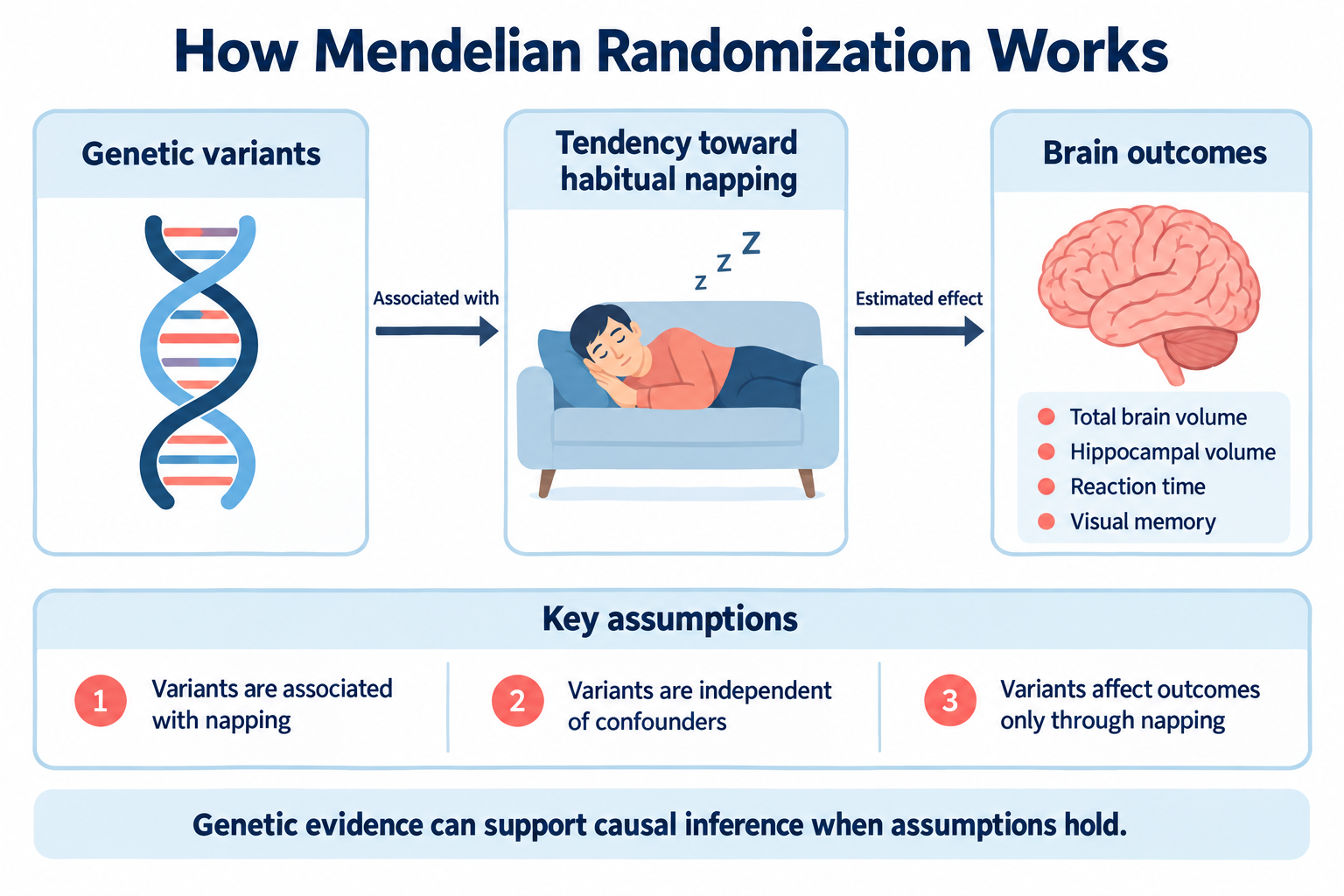
The study used Mendelian randomization, a method that uses genetic variants associated with an exposure, such as habitual napping, to investigate its possible effects on health outcomes.
This approach can help address a challenge in observational research: people who nap may differ from people who do not in many other ways.
For example, an observed relationship could reflect underlying health, sleep patterns, or other characteristics rather than an effect of napping itself.
How Was the Study Conducted?
The main analysis used 97 genetic variants associated with habitual daytime napping. Brain imaging and genetic data were available for 35,080 participants within the larger UK Biobank dataset. UCL News
Does Mendelian Randomization Prove Causation?
Mendelian randomization can strengthen a causal argument when its assumptions hold. However, it is not equivalent to a randomized clinical trial.
The authors described their findings as suggesting a modest causal association, and called for replication using other datasets and methods.
4. Larger Brain Volume Did Not Come With Clear Cognitive Benefits
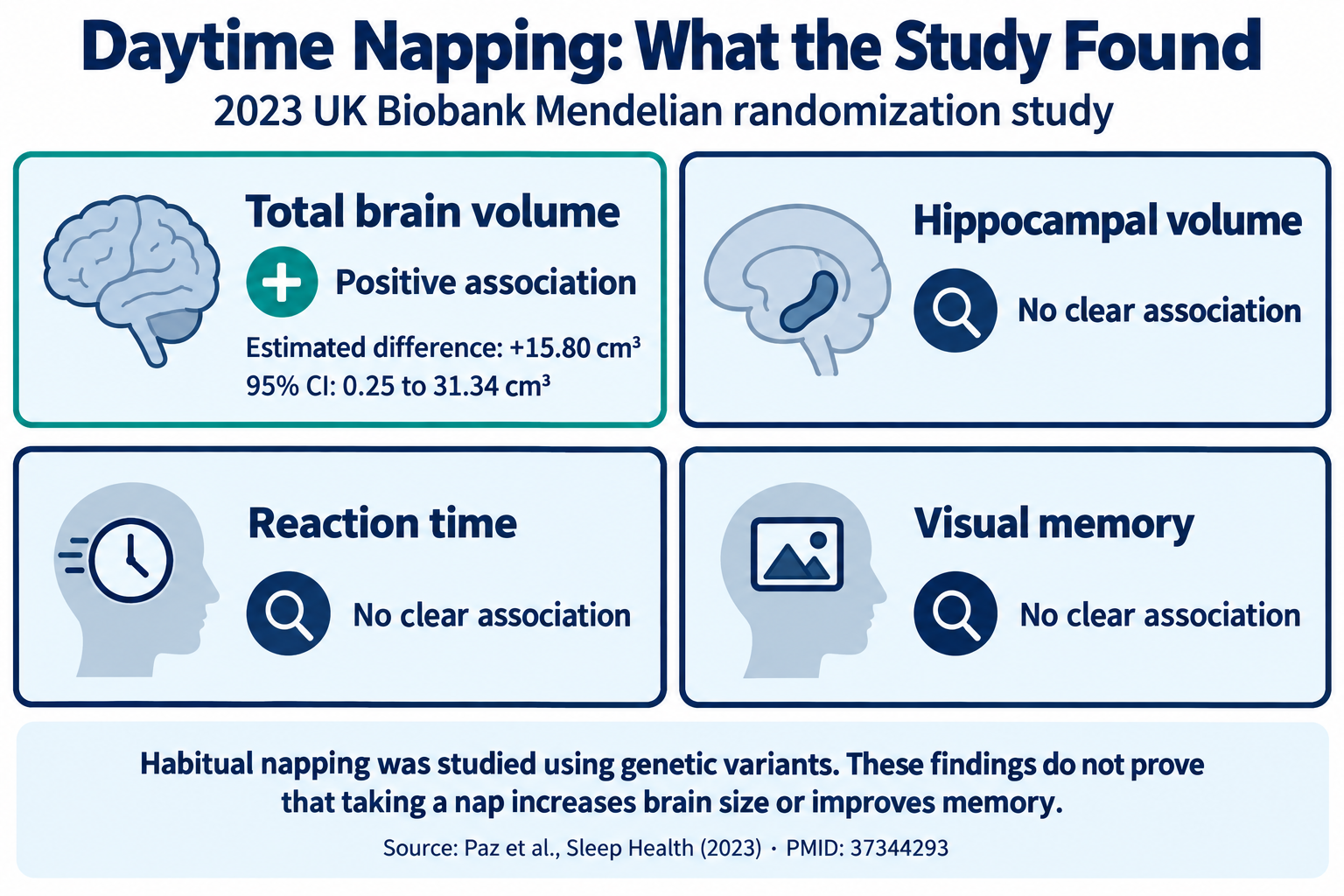
The study examined several outcomes, and the results were not the same for each one.
| Outcome | Reported estimate and 95% confidence interval | Interpretation |
|---|---|---|
| Total brain volume | β = 15.80 cm³; 0.25 to 31.34 | Evidence supporting a positive association |
| Hippocampal volume | β = −0.03 cm³; −0.13 to 0.06 | No clear association |
| Reaction time | expβ = 1.01; 1.00 to 1.03 | No clear association reported by the authors |
| Visual memory | expβ = 0.99; 0.94 to 1.05 | No clear association |
The outcomes use different measurement scales, so their numerical estimates should not be compared directly.
Why This Distinction Matters
A structural finding does not automatically demonstrate better thinking skills.
The study does not justify claims that habitual napping increases intelligence, improves memory, or makes people react faster. Its positive finding concerned total brain volume.
Likewise, not finding a clear association with a particular cognitive test does not establish that naps have no cognitive effects under any circumstances.
5. Additional Analyses Helped Check the Findings
The researchers conducted additional analyses to investigate whether certain factors could influence their results.
These included analyses using:
- 47 genetic variants, adjusted for excessive daytime sleepiness.
- 86 genetic variants, excluding variants associated with sleep apnea.
- 17 genetic variants, without sample overlap with UK Biobank.
The findings were largely consistent with the main analysis.
What Is Horizontal Pleiotropy?
Horizontal pleiotropy occurs when a genetic variant affects the outcome through a pathway other than the exposure being studied. This can complicate the interpretation of Mendelian randomization.
The researchers found no evidence of horizontal pleiotropy in their analyses. That supports their interpretation, although a test finding no evidence cannot guarantee that every possible source of bias has been excluded.
6. The Study Did Not Identify an Ideal Nap Length
Readers looking for interesting facts about sleep often want a practical answer: how many minutes should a nap last?
This study cannot answer that question. The researchers did not have information on nap duration, so the findings do not establish an ideal length, frequency, or time of day for napping. UCL News
Why Nap Duration Matters When Interpreting Headlines
“Habitual daytime napping” describes a tendency or behavior. It does not specify one standardized nap routine.
For that reason, headlines claiming that a particular number of minutes will increase brain volume go beyond what this study demonstrated.
7. The Findings May Not Apply Equally to Everyone
The study’s participants were of white European ancestry. This limits how confidently the results can be applied to people from other ancestry groups.
Replication in more diverse populations would help researchers assess whether the association is consistent across different groups. UCL News
What Should Future Research Explore?
The authors called for further studies of other cognitive and brain outcomes, as well as replication using different methods and datasets.
Useful questions include whether the association differs by nap duration, age, or nighttime sleep patterns, and whether it translates into meaningful changes in everyday functioning.
Frequently Asked Questions About Sleep and Daytime Napping
What Are Some Interesting Facts About Sleep and the Brain?
Sleep supports learning and long-term memory formation. Research also suggests that a genetic tendency toward habitual daytime napping may be associated with larger total brain volume, although this does not establish better memory or intelligence. NHLBI, NIH
Does Daytime Napping Increase Brain Volume?
The 2023 study suggested a modest causal association between habitual daytime napping and larger total brain volume. It did not directly test whether asking someone to begin napping would increase their brain volume.
Did the Study Find That Napping Improves Memory?
No clear association was found with visual memory in this study. That finding relates to the particular outcome and method examined; it should not be generalized to every type of memory or nap.
Did Napping Affect Hippocampal Volume?
The researchers did not find a clear association between habitual daytime napping and hippocampal volume.
How Long Should I Nap for Better Brain Health?
This study did not establish a recommended nap duration. Its findings should not be used to prescribe a specific nap length.
Does This Research Prove That Naps Prevent Dementia?
No. Dementia prevention was not an outcome established by this research. Larger total brain volume should not be treated as proof that napping prevents dementia.
Who Authored the Napping and Brain Volume Study?
Valentina Paz and colleagues authored the study, titled “Is there an association between daytime napping, cognitive function, and brain volume? A Mendelian randomization study in the UK Biobank.” It appeared in the October 2023 issue of Sleep Health.
Original research: Read the study on PubMed.



Leave a Reply