

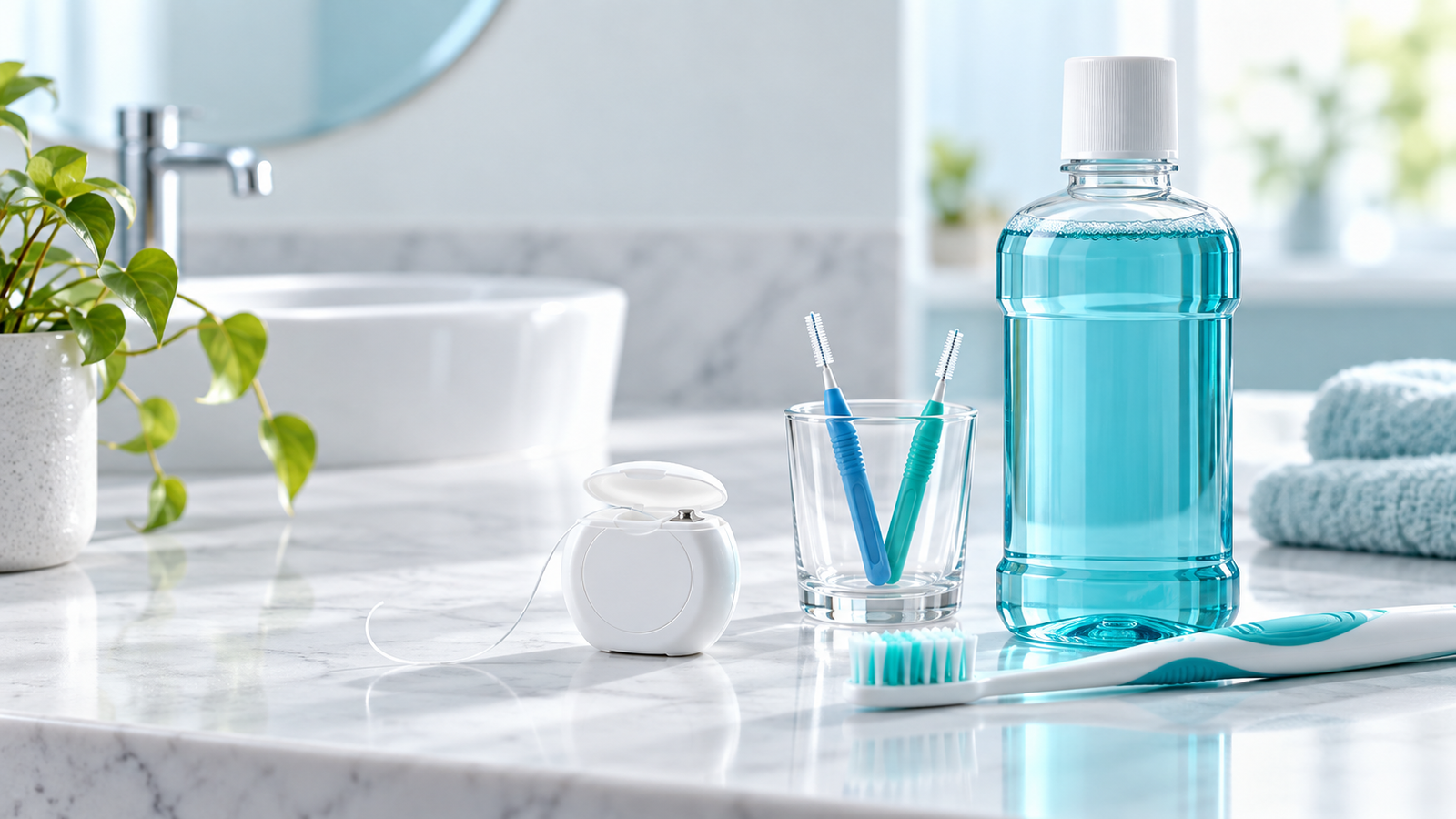
The benefits of flossing and mouth rinsing are easiest to understand when each habit has a clear job. Brushing cleans accessible tooth surfaces. Interdental cleaning reaches spaces a toothbrush cannot clean well. A suitable therapeutic rinse can provide an additional effect, depending on its ingredients. These approaches work together; a fresh taste is not evidence that plaque has disappeared.
This guide explains what clinical research can tell us, what it cannot establish, and how to turn general recommendations into a practical conversation with your dentist. It is written for adults seeking understandable dental-health information, rather than a shopping list or a promise of perfect gums.
Editorial note: Prepared for Lattivelle on October 16, 2026. Sources are linked throughout and listed below. This article has not been independently reviewed by a dental clinician.
Benefits of flossing and mouth rinsing: the short answer
Daily cleaning between teeth can complement brushing, while an appropriately selected mouthrinse may help address a particular concern such as plaque, gingivitis or cavity risk. The right combination depends on your teeth, gums, restorations, ability to handle cleaning tools and professional recommendations. The American Dental Association recommends brushing twice daily and cleaning between teeth once daily with floss or another suitable interdental cleaner. [3]
It helps to distinguish an essential habit from an optional addition. Most people need a workable way to clean between their teeth. Not everyone needs the same rinse, and some people do not need a routine mouthrinse at all. An expensive bottle is not automatically a more useful choice than an affordable cleaning aid that you can use comfortably and consistently.
The most helpful question is therefore not, “Which one wins?” It is, “Which areas am I missing, and what additional problem am I trying to solve?” That question changes the discussion from buying products to improving a routine.
Understand plaque before comparing products
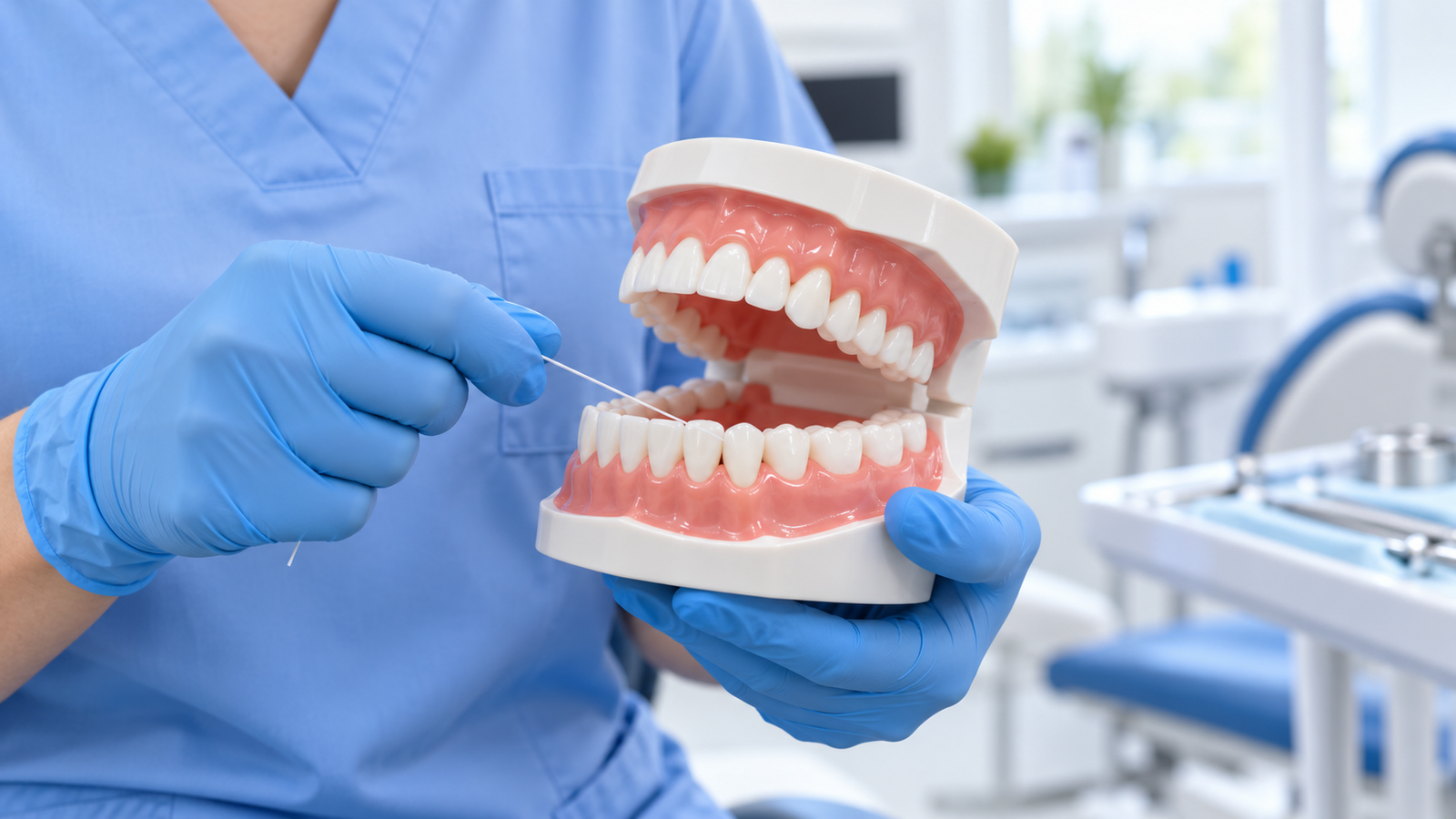
Dental plaque is a biofilm that develops on oral surfaces. It is not simply the piece of lunch you can see between two teeth. Plaque can accumulate around the gumline, tooth contacts and dental restorations even when your mouth feels fresh. If plaque hardens into calculus, also called tartar, home brushing or flossing cannot remove that hardened deposit; professional cleaning is needed. [4]
Think of a cleaning routine as a coverage problem. A toothbrush has areas it reaches well and areas that are harder to access. Floss and other interdental tools offer access from a different direction. A rinse distributes liquid around the mouth, but distribution is not identical to mechanically cleaning a surface. These differences explain why a dentist may recommend a combination rather than a single favorite item.
A useful personal inventory includes where food catches, where a tool feels awkward, and which areas you consistently skip. Bring those observations to a dental appointment. They are more actionable than telling yourself that your mouth is “generally clean” or “always bad.”
Gingivitis and periodontitis are not interchangeable
Gingivitis refers to inflammation of the gums. Periodontitis involves damage to the tissues that support teeth and requires professional assessment and management. Gum redness, swelling or bleeding deserves attention, but a person cannot reliably stage gum disease by looking at a mirror or comparing photographs online. NIDCR explains that plaque-related gingivitis can often improve with effective daily cleaning, while established supporting-tissue damage needs more than a cosmetic rinse. [5]
This distinction matters when reading headlines. A trial showing improvement in a gingivitis score over several weeks does not prove that the same regimen prevents every case of tooth loss over decades. Nor does a reduction in plaque automatically mean that an existing periodontal problem has been treated. Match the outcome in the study to the claim being made.
What the 2022 flossing and mouthrinsing trial studied
The study supplied for this article is Bosma and colleagues’ Efficacy of Flossing and Mouthrinsing Regimens on Plaque and Gingivitis: A randomized clinical trial, published in the Journal of Dental Hygiene in 2022, volume 96, issue 3, pages 8–20. It examined supervised regimens over 12 weeks. Of 156 randomized participants, 149 completed the trial. [1]
The study compared an essential-oil mouthrinse regimen, professional flossing, supervised self-flossing and a negative-control rinse regimen. Its design is useful because technique and adherence can influence what a product appears to achieve. Professional flossing is also a different intervention from giving someone a floss container and assuming they will use it correctly every evening.
The accessible research summaries support benefits in gingival-health measures with flossing regimens and additional effects from the studied essential-oil rinse. However, this article does not reproduce numerical superiority claims from the full trial because the journal full text was not accessible during verification. The article page also flags a correction. Readers evaluating exact estimates should consult the corrected publication, not a marketing graphic. [1]
Do not confuse the 2022 and 2024 trials
A separate paper with a very similar title appeared in BMC Oral Health in 2024. It randomized 270 adults with gingivitis among five regimens, including brushing alone, brushing with an alcohol-containing or alcohol-free essential-oil rinse, brushing with flossing, and a combined regimen. It reported further improvements when a studied rinse was added. This was a different trial, not a larger sample of the original 2022 study. [2]
That distinction protects readers from a common research error: mixing the participant count from one study with the results of another. It also prevents a broad claim about “mouthwash” from being substituted for evidence about particular formulations and supervised instructions.
Neither trial means that all commercially available rinses have identical effects. A product’s active ingredients, concentration, directions and intended use matter. A homemade essential-oil mixture is not equivalent to a standardized formulation tested in a clinical trial.
How to read dental research without overinterpreting it
Start with the comparison. “Better than control” is incomplete unless the control is described. Brushing alone, a placebo rinse and professional cleaning are different reference points. Also ask whether participants received a cleaning at the start, whether their routine was supervised, and whether the same examiner assessed outcomes. Those details influence how closely the results resemble ordinary home use.
Next, identify the outcome. Plaque, gingival inflammation, bleeding and tooth decay are related subjects but distinct measurements. A study may be designed to answer one question and provide little information about another. Read the actual endpoint rather than the most attractive phrase in a headline.
Finally, separate statistical significance from practical importance. A measurable average difference may be small, uncertain or dependent on the people studied. Your own dental history could make another question more important, such as whether a particular tool can clean safely around a bridge.
What systematic reviews add
A 2019 Cochrane review included 35 studies involving 3,929 adults. It found that adding floss or interdental brushes to brushing may reduce gingivitis or plaque, with some comparisons favoring interdental brushes. Much of the evidence was low or very low certainty, outcomes were usually short term, and evidence for long-term decay or periodontitis outcomes was limited. [6]
Low certainty is not the same as “proven useless.” It means confidence in a particular estimate is limited. Conversely, a professional recommendation does not turn every possible benefit into a certainty. A balanced conclusion recognizes both the rationale for cleaning missed surfaces and the limitations of the research used to quantify outcomes.
This is why a practical recommendation can remain sensible while an exaggerated advertisement remains unsupported. You can adopt a low-cost cleaning habit without believing that it guarantees protection against every dental disease.
Floss, interdental brushes and water flossers
“Flossing” is often used as shorthand for all cleaning between teeth, but different tools suit different spaces. Traditional string floss can fit close contacts. An interdental brush may suit a larger space when correctly sized. An oral irrigator may be useful for some people who find other devices difficult. Ask a dental professional which method fits your anatomy and restorations. [3]
| Tool | Question to ask your dental professional | Practical consideration |
|---|---|---|
| String floss or tape | Can you demonstrate how to clean both tooth surfaces at this contact? | Hand position and control matter. |
| Floss holder | Will this shape reach my back teeth adequately? | A handle may make a routine easier. |
| Interdental brush | What size fits each space without force? | One size may not fit the whole mouth. |
| Water flosser | Which tip, pressure and technique suit my situation? | Setup, cleaning and counter space affect use. |
| Specialized threader | How should I clean beneath this bridge or wire? | Restoration-specific instruction is important. |
The purpose of this table is to help prepare questions, not prescribe a device. Buying every option at once makes it harder to know what works for you. A focused demonstration is often more useful than adding another unopened product to a drawer.
Make the demonstration specific
Instead of asking, “Am I flossing correctly?” point to an actual difficult area. You might say, “This lower back contact catches the floss, and I cannot tell whether I am touching the tooth or the gum.” That gives the clinician something concrete to inspect. Bring the device you use, or a clear photograph of its package, so the advice relates to your real routine.
After the demonstration, describe the steps back in your own words. Ask whether the same technique applies everywhere or whether one area needs a different tool. A short written note can prevent confusion later. This is especially helpful if several products have similar names or if the appointment includes many other instructions.
How to approach flossing gently
General instructions describe guiding floss carefully through a contact, curving it against a tooth surface and moving it gently rather than snapping it into the gums. Clean the neighboring tooth surface as well, using a clean section as you move along. Individual anatomy, dental work and periodontal treatment can change the technique you need. NIDCR’s oral-hygiene resources provide illustrations and emphasize avoiding force. [7]
Practice matters more than speed. If an awkward hand position makes you rush, stop and ask about a holder or another method. Persistent shredding, a sharp catch or pain is information to report, not a challenge to overpower. Do not use improvised sharp objects to force material from a difficult space.
For someone beginning a routine, the first goal can be learning a repeatable sequence. For example, move through the upper teeth in an orderly pattern, then the lower teeth. An orderly route reduces accidental omissions without requiring an elaborate tracking app.
What if the gums bleed?
Bleeding can accompany inflammation, but it can also reflect trauma or other problems. Do not assume every episode is harmless, and do not respond by scrubbing more aggressively. Persistent, recurrent or unexplained bleeding should be evaluated, especially with swelling, pain, recession or loose teeth. CDC’s gum-disease information describes bleeding and other warning signs that deserve attention. [8]
Useful details to record include whether bleeding occurs in one location or throughout the mouth, whether it happens spontaneously, and whether you changed tools recently. Mention relevant medicines and medical conditions at your appointment. These observations assist evaluation; they cannot determine the cause by themselves.
If a professional has recently treated your gums, follow the personalized aftercare instructions rather than switching to a generic internet routine. The correct response after a procedure may differ from everyday maintenance.
Mouthrinse is a category, not a single treatment
Cosmetic rinses mainly offer a temporary taste or breath effect. Therapeutic rinses contain ingredients intended to address specific oral-health concerns. Their benefits differ by formulation, and a rinse does not replace brushing or interdental cleaning. The ADA distinguishes these categories and cautions against routine mouthrinse use in children under six unless a dentist directs it. [9]
Read the intended-use statement before reading the advertising slogan. A product aimed at cavity prevention answers a different question from one aimed at gum inflammation. A whitening claim does not automatically establish an antigingivitis effect. A “natural” description is not a substitute for evidence about the finished product.
If you cannot explain why you are using a rinse, that is a good reason to ask your dentist. The answer might be to continue it, change formulation, adjust timing or leave it out. More steps are not always a better routine.
Fluoride rinses and cavity prevention
Fluoride supports protection against tooth decay, but not every person requires an additional fluoride rinse. A dentist can assess cavity risk and the fluoride products already in use. Tooth decay involves the balance between mineral loss and repair; fluoride toothpaste remains a foundational tool. NIDCR explains the decay process and the role of fluoride. [10]
A useful product review starts by listing toothpaste, prescription products and any rinse rather than considering each item in isolation. Ask, “What is the purpose of each one, and when should I use it?” Write down the answer. This avoids accidental duplication and makes a routine easier to follow.
Do not treat a pleasant flavor as proof of cavity protection, and do not dilute or alter a product unless the label or your clinician instructs you to do so.
Antiseptic rinses and gingival health
Some therapeutic formulations are studied for plaque and gingivitis control. Their role is usually adjunctive: they add something to mechanical cleaning. The 2024 essential-oil trial illustrates why the exact formulation matters; its findings should not be generalized to every rinse or to homemade mixtures. [2]
When someone says a rinse “worked,” ask what improved. Was there less bleeding noted at an examination, a lower plaque score, or simply a fresher feeling? Personal comfort matters, but it is a different kind of observation from a clinical measurement. Keeping those categories separate makes a follow-up appointment more informative.
Also tell your dentist whether you can tolerate the taste and sensation. A formulation that you consistently avoid cannot serve its intended purpose. There may be another approach that better fits your needs.
Chlorhexidine needs a defined purpose
Chlorhexidine mouthrinse can reduce plaque as an adjunct to cleaning, but it is not a casual upgrade for everyone. A Cochrane review reported staining and other adverse effects, including taste disturbance, in studies of its use. Decisions about indication and duration should come from a dental professional. [11]
If it is prescribed, ask four questions: Why do I need it? How long should I use it? What effects should I report? When will the plan be reviewed? Put the review date next to the product rather than assuming it is now a permanent part of your routine.
Do not share a prescription bottle with a family member. Similar-looking gum symptoms do not establish the same diagnosis or justify the same treatment. Avoid adding other active rinses without discussing the combination.
Timing, toothpaste and rinsing
A common source of confusion is whether mouthrinse belongs immediately after brushing. NHS advice recommends spitting after fluoride-toothpaste brushing rather than rinsing it away and using mouthwash at another time. Product-specific instructions and prescription directions can differ, so ask your dentist how to coordinate the items you actually use. [12]
There is no need to invent a complicated schedule from social-media tips. Write a simple sequence that matches professional instructions. If the plan says to use a rinse at a separate time, choose an existing daily cue that makes sense. If a prescription includes a waiting interval, record that exact interval rather than guessing.
Flossing before or after brushing can both be acceptable when cleaning is thorough. The repeatable time you can maintain is more useful than an idealized schedule you abandon. [3]
Build an oral-care plan around your real life
Consider three questions: What do I need to do? What makes it difficult? What is the smallest practical change that addresses the difficulty? This is a planning exercise, not a clinical protocol. Someone who forgets may need a visible reminder. Someone with painful hands may need a different handle. Someone confused by multiple products may need fewer, clearer instructions.
For example, an evening routine might be written on a card near the toothbrush. The card could list cleaning between teeth, brushing, and any clinician-directed additional step. Keep the wording consistent with your care plan. Avoid putting every dental tip you have ever read onto the same card.
The aim is to reduce decisions at the moment you are tired. A routine that requires searching for supplies or remembering several contradictory instructions has unnecessary friction. Organize the environment so that the agreed plan is easy to carry out.
A sample habit worksheet
| Prompt | Example of a useful answer |
|---|---|
| What keeps getting missed? | I skip the back teeth because I cannot reach comfortably. |
| What will I ask? | Can you demonstrate a tool with a handle? |
| Where will supplies stay? | In one clean, accessible place beside my usual brushing supplies. |
| What will I record? | Questions, discomfort and any recurring difficult area. |
| How will I review it? | Bring the note and actual tool to my next appointment. |
These examples are organizational suggestions. They do not diagnose gum disease or tell you which device is medically appropriate. Their value is making your next professional conversation more specific.
Special situations deserve individual instructions
Braces, bridges, implants and retainers
Dental work changes the cleaning landscape. A contact beneath a fixed bridge is not the same as the space between two natural teeth. Orthodontic wires, implant components and retainers may require particular tools or instructions. Ask the treating professional to show exactly where a device should travel and which parts should not be forced. [13]
Take a photograph of the recommended product if the name is unfamiliar. Ask for a demonstration on your own dental work when possible, rather than relying solely on a generic model. If one tool is intended for the restoration and another for the remaining contacts, label them clearly at home.
Do not interpret “clean thoroughly” as “use more pressure.” Better access and a suitable tool are more useful discussion points than force.
Dry mouth and sensitive tissues
A dry or easily irritated mouth can make product choice more complicated. Some people find strong flavors or alcohol-containing formulations uncomfortable. Dry mouth itself can have several causes, including medicines and medical conditions, so persistent symptoms deserve assessment rather than simply buying a stronger breath product. NIDCR provides information on evaluation and care for dry mouth. [14]
Bring a list of medicines and the products you use, including over-the-counter items. Describe when dryness is worst and whether it affects eating, speaking or sleep. Do not discontinue a prescribed medicine because you suspect it contributes to dryness; ask the prescriber and dentist to review the situation together.
Diabetes, pregnancy and ongoing treatment
People with diabetes should include oral health in their ongoing care discussions. NIDCR describes a relationship between diabetes and periodontal disease, with blood-glucose management and dental care both relevant. Pregnancy can also affect oral-health needs, making individualized advice preferable to a generic rinse recommendation. [15] [16]
Tell your dental team about relevant diagnoses, pregnancy, recent treatment and changes in medication. This is context for safe advice, not a reason to assume that you cannot maintain ordinary oral hygiene. If you have been given a specialized plan, ask how it fits with your existing products before changing anything.
Common myths about flossing and mouth rinsing
“If my breath smells fresh, my gums are healthy”
A flavor change is not an examination. Breath, plaque, inflammation and supporting-tissue health cannot be reduced to one sensation. Use fresh breath as a comfort preference, not a diagnostic test. If a persistent odor is worrying you, describe it honestly at an appointment instead of continually masking it with stronger products.
“The strongest burning sensation means the best cleaning”
Intensity is not a reliable measure of benefit. Product selection should depend on intended use, evidence, tolerance and appropriate instructions. If a rinse causes significant discomfort, stop using the irritating product and ask for guidance. There is no advantage in treating pain as proof that an item is doing its job.
“Mouthwash can replace the cleaning step I dislike”
It is tempting to substitute a quick swish for an awkward task, but that changes the routine being recommended. Explain the awkward task to your dentist. The solution might be an alternative interdental tool or a better technique, rather than abandoning access to those surfaces altogether. [9]
“An expensive tool must be clinically superior for me”
Price can reflect design, features, branding or convenience. It cannot independently establish suitability for your teeth. Ask what feature solves your actual problem. If a basic device meets the same need and you can use it well, a more elaborate purchase may add little practical value.
How to compare products without turning the aisle into a research project
Begin with the reason for buying the product, then check the active ingredient and directions. Look for an appropriate independent acceptance mark where relevant, and understand that acceptance relates to specific claims rather than every possible benefit. The ADA describes how its Seal of Acceptance evaluates submitted safety and efficacy evidence. [17]
Write the product name and intended purpose in one sentence: “This was recommended for this concern, to be used in this way.” If you cannot complete the sentence, postpone adding it until you can ask. This simple test helps separate an evidence-based recommendation from an impulse purchase.
Keep packaging until you know the instructions. Small differences in labeling can matter, and a clinician can provide more useful guidance from the actual product name than from “the blue bottle.”
When dental symptoms need attention
Arrange professional assessment for recurring bleeding, persistent bad breath, gum tenderness, recession, pain when chewing, pus or loose teeth. Seek urgent advice for significant pain or rapidly increasing swelling. Difficulty breathing or swallowing with facial or neck swelling requires emergency care. Do not try to manage those symptoms by escalating flossing or mouthrinse use. [8] [18]
When contacting a practice, describe the symptom, location, start time and whether it is worsening. Mention fever, trauma, recent procedures or medication changes when relevant. Clear observations help the team decide how quickly you need to be seen. A photograph may assist communication, but it does not replace an examination.
Questions to bring to your next dental appointment
Choose the questions that match your situation rather than reading a long checklist aloud. Useful starting points include: What is the health of my gums today? Which areas need better cleaning? Which tool fits those spaces? Do I need a therapeutic rinse, and for what purpose? Are there instructions specific to my restorations?
Also ask how progress will be evaluated. A follow-up based on professional findings is more meaningful than simply asking whether your mouth feels cleaner. If cost, dexterity, a gag reflex, time or sensory discomfort is affecting your routine, say so. A care plan is more useful when the professional understands the barrier.
Request one or two priorities if the full plan feels overwhelming. This does not mean ignoring the rest. It means leaving with a clear starting point and a way to clarify uncertainties before they become reasons to stop.
A practical worksheet for your next dental visit
General advice becomes more useful when it is tied to a specific question. Before your next appointment, write down what you actually do rather than what you think the ideal routine should look like. For example: “I brush in the morning and before bed, clean between my front teeth most evenings, and use a rinse when my mouth feels stale.” That description gives the dental team a starting point. It is more informative than saying that you have a good or bad routine.
Next, identify the obstacle. Is the floss difficult to hold? Does it catch beside one particular restoration? Are you unsure whether the brush fits? Does the taste of the rinse put you off using it? These are different problems, so they should not automatically lead to the same purchase. Bring the tool or a photograph of its packaging, and ask for a demonstration. The aim is to leave with instructions that fit your mouth and your abilities.
Separate the goal from the marketing claim
Imagine two bottles on a shelf. One emphasizes fresh breath, while the other describes an active ingredient and a particular oral-health purpose. Their appearance and price cannot tell you whether either product belongs in your routine. Write down the goal first: are you asking about cavity prevention, gum inflammation, dry-mouth comfort or something else? Then ask whether the ingredient, instructions and warnings match that goal. This exercise does not select a treatment; it helps you frame a sensible conversation.
Keep the original label available. A product name alone can be misleading when a brand sells several formulations. Record the exact formulation, the recommended amount, the age restrictions and any directions about duration. If a dentist recommends a rinse, ask what benefit they expect, how long to use it and what should happen at the review appointment. An instruction to “use mouthwash” is less helpful than a clear purpose and a plan.
Use a routine log without turning it into a diagnosis
A simple log can record whether you completed brushing and interdental cleaning, which tool you used, and any difficulty you want to discuss. You do not need a numerical gum score or an app that claims to diagnose disease. If bleeding or discomfort occurs, describe the location and pattern in plain language. Do not repeatedly poke an area to test it, or delay an appointment while trying to produce a perfect record.
Suppose you miss several evenings because the supplies are stored in a different room. Moving them to a convenient, safe place may address that practical barrier. If the barrier is pain or a tool that repeatedly catches, convenience alone does not solve the problem. That is a reason to ask for professional assessment. The useful distinction is between a habit that is inconvenient and an experience that needs clinical attention.
Agree on what success will mean
At the appointment, ask the team to explain which findings they will reassess. A pleasant taste, a smoother feeling and an attractive product package are not interchangeable with a professional assessment of oral health. You can contribute a reliable description of your routine, while your dental team assesses the clinical findings and decides whether changes are needed.
End the conversation by repeating the plan in your own words: which tool, which areas, how often, whether a rinse is indicated, and when to return. Ask what to do if the plan causes difficulty. This “teach-back” approach is a communication aid, not a test of the patient. A modest routine that you understand and can carry out is a more useful starting point than a complicated list of products whose purposes are unclear.
Frequently asked questions
Is flossing necessary if I brush carefully?
Careful brushing does not provide identical access to every surface between teeth. Dental organizations recommend adding an appropriate interdental-cleaning method. The method can be floss or another tool that suits your spaces and abilities. Ask for individualized instruction if string floss is difficult; the objective is effective coverage, not loyalty to one format. [3]
Should everyone use mouthrinse daily?
No single rinse is necessary for every adult. Whether it adds value depends on the concern being addressed and the products already in your plan. A dentist may recommend a therapeutic formulation for a reason, while someone else may not need one. Read the directions and avoid treating rinse as a replacement for cleaning. [9]
Is an alcohol-free mouthrinse automatically better?
Alcohol-free describes one formulation feature, not a complete assessment of effectiveness or suitability. Tolerance, active ingredients, age restrictions and the reason for use matter. Compare actual products and their evidence with professional guidance. Do not assume that two products provide the same effect because both use the words “alcohol-free.”
Can floss remove tartar?
No. Once a deposit has hardened into calculus, it requires professional removal. Increasing pressure or trying to scrape it yourself risks harm. Home cleaning supports ongoing plaque control but cannot replace the appropriate professional procedure. Ask your dental team to show which areas need attention after cleaning. [4]
How soon should I notice improvement?
There is no universal timetable suitable for every mouth or every diagnosis. Clinical trials assess groups over defined periods; those averages do not set a deadline for your symptoms. Follow your dentist’s review plan and seek assessment for persistent or worsening problems rather than waiting for a predicted number of days.
Can children use the same rinse as adults?
Not automatically. Age restrictions, swallowing ability and the particular formulation matter. The ADA advises against mouthrinse in children younger than six unless directed by a dentist. Keep products out of children’s reach and follow the specific label, including any stricter age limit. Ask a pediatric dental professional when unsure. [9]
Does this research prove mouthrinse prevents heart disease?
No. The discussed dental trials assessed oral-health outcomes such as plaque and gingivitis, not prevention of heart attacks. Do not extend their results to a different medical outcome. Oral care belongs within general healthcare, but a good habit does not justify an unsupported claim about another disease.
What is the most useful first step?
Review what you already use and identify the part you cannot perform comfortably or consistently. Bring that specific issue to a dentist or hygienist. A demonstration and a clear reason for each product give you a more useful starting point than buying a complete new routine based on a headline.
References and further reading
- Bosma ML and colleagues. Efficacy of Flossing and Mouthrinsing Regimens on Plaque and Gingivitis: A randomized clinical trial. Journal of Dental Hygiene. 2022;96(3):8–20. PubMed record. Consult the corrected journal version for detailed numerical findings.
- Bosma ML and colleagues. Efficacy of flossing and mouth rinsing regimens on plaque and gingivitis: a randomized clinical trial. BMC Oral Health. 2024;24:178. DOI: 10.1186/s12903-024-03924-4.
- American Dental Association. Dental Floss/Interdental Cleaners.
- NIDCR. Ask the Expert: Do I Really Need to Floss?
- NIDCR. Periodontal (Gum) Disease.
- Worthington HV and colleagues. Home use of interdental cleaning devices, in addition to toothbrushing. Cochrane Review, 2019.
- NIDCR. Oral Hygiene.
- CDC. About Periodontal (Gum) Disease.
- American Dental Association. Mouthrinse (Mouthwash).
- NIDCR. The Tooth Decay Process: How to Reverse It and Avoid a Cavity.
- Cochrane. Chlorhexidine mouthrinse to reduce gingivitis and plaque build-up.
- NHS. Gum disease.
- American Dental Association. Home Oral Care.
- NIDCR. Dry Mouth.
- NIDCR. Diabetes and Oral Health.
- CDC. Pregnancy and Oral Health.
- American Dental Association. ADA Seal of Acceptance Product Categories.
- NHS. Dental abscess.
Reminder: This educational guide does not replace a personal dental examination. Use the references to understand the evidence and your dental team to decide what belongs in your own care plan.