

Tirzepatide microdosing is a term used to describe taking smaller amounts of tirzepatide than those specified in a standard treatment schedule. Online charts may show how different liquid volumes correspond to different amounts of medication. However, understanding a chart’s calculations is different from establishing whether a treatment approach is appropriate.
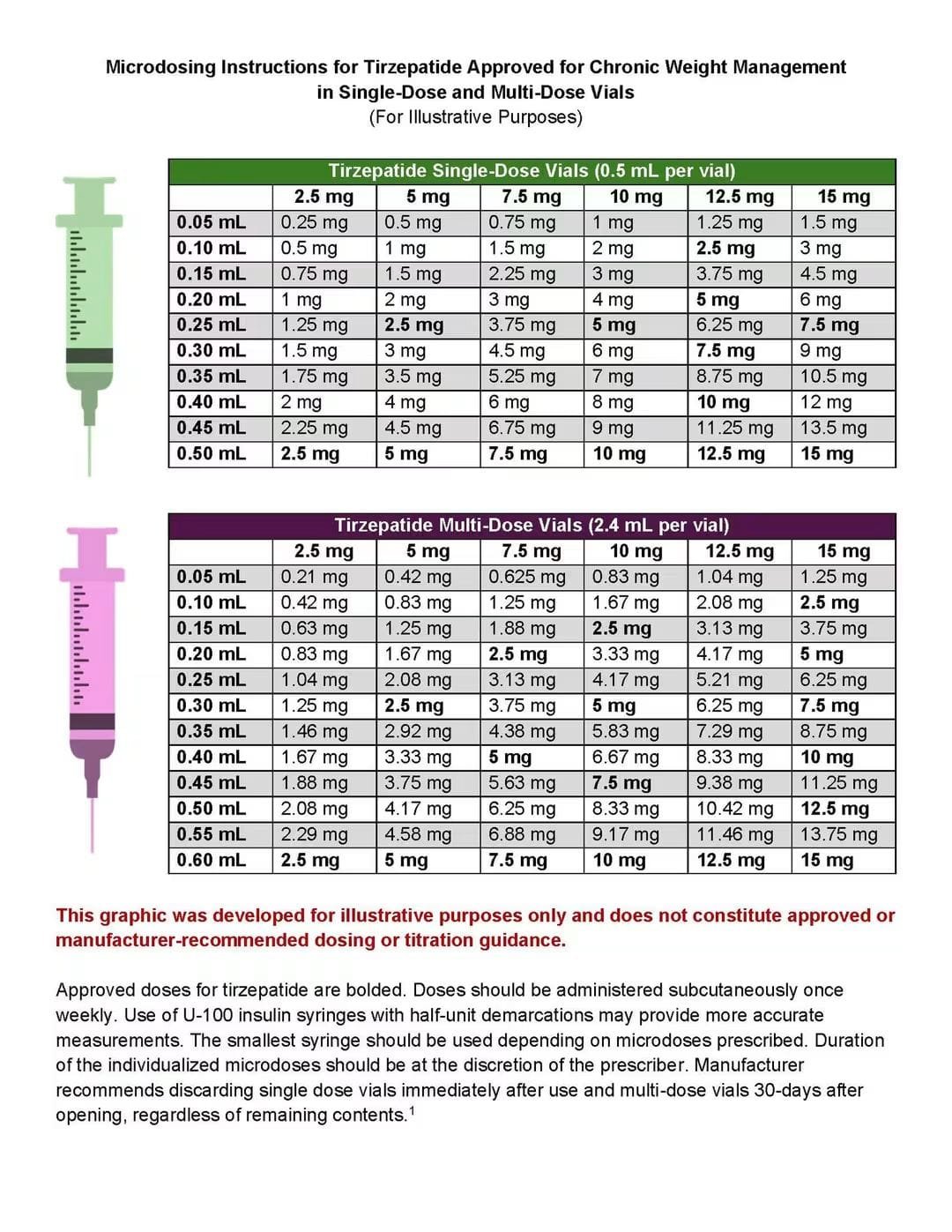
The image accompanying this article illustrates partial doses from single-dose and multi-dose vials. It also includes an essential disclaimer: the graphic is illustrative and does not constitute approved or manufacturer-recommended dosing guidance.
For readers exploring tirzepatide for weight management, that distinction deserves attention. A medication can be approved for a particular condition while an alternative dosing method remains outside its approved instructions.
Medical information: This article explains the supplied graphic. It is not a dosing guide. Follow the instructions for your prescribed product and consult your prescriber or pharmacist before changing treatment.
What Is Tirzepatide Microdosing?
“Microdosing” can mean different things in online discussions. Some people use it to describe doses below the labeled starting dose. Others use it to describe dividing a scheduled dose into smaller administrations.
These approaches should not be treated as interchangeable. Changing the amount administered and changing the timing of administration are separate treatment decisions.
The current U.S. Zepbound prescribing information specifies a once-weekly treatment schedule with gradual dose escalation. It does not provide the partial-dose microdosing protocol shown in the supplied image. pi.lilly.com
Tirzepatide Microdosing Versus Gradual Dose Escalation
Gradual dose escalation means moving through a prescribed treatment schedule under clinical supervision. The existence of a lower starting dose does not establish that any smaller dose or alternative schedule has equivalent evidence.
When reviewing information online, ask:
- Does the source describe the approved product instructions?
- Is it reporting results from a clinical study?
- Is it explaining a clinician’s individual treatment decision?
- Is it simply presenting a mathematical conversion?
These are different types of information. A dosing table may answer a mathematical question while leaving questions about effectiveness, safety, and appropriate use unanswered.
Tirzepatide Microdosing Charts Are Not Prescriptions
The supplied image contains rows of liquid volumes and columns of medication strengths. Each intersection represents a calculated amount of medication.
That layout can look authoritative, particularly when certain entries appear in bold. But bold formatting does not demonstrate that every route to that amount, every presentation, or every administration schedule is approved.
The image’s own disclaimer is therefore central to interpreting it.
Understanding Milligrams, Milliliters, and Concentration
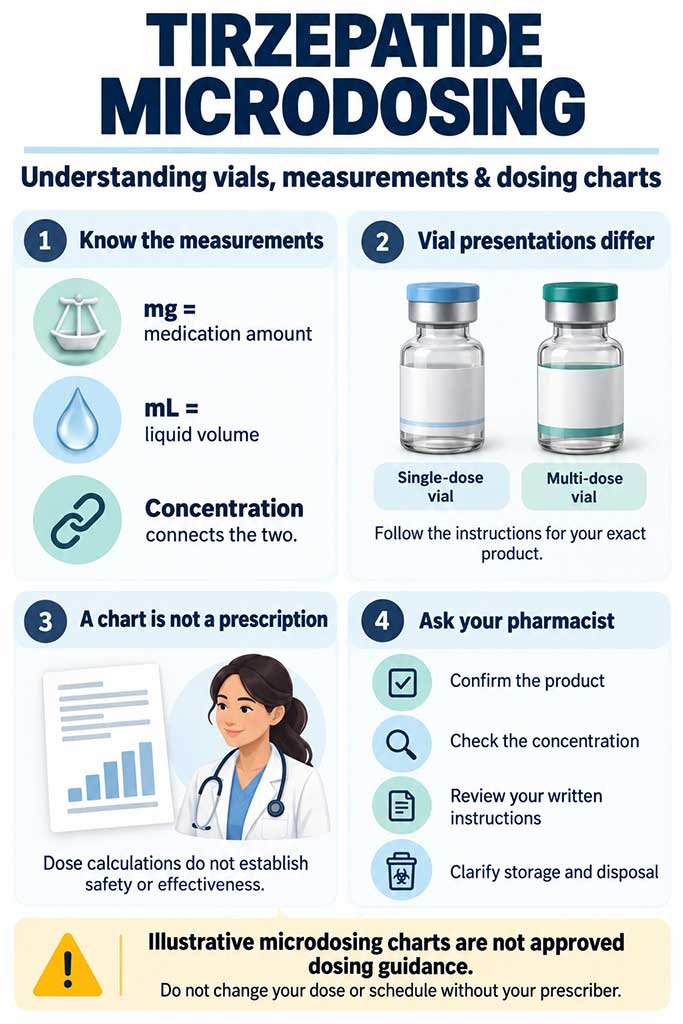
Medication charts become easier to understand when three concepts are kept separate.
| Term | Meaning | Why it matters |
|---|---|---|
| Milligrams, or mg | Amount of active medication | Describes the medication dose |
| Milliliters, or mL | Volume of liquid | Describes how much liquid is measured |
| Concentration | Medication amount within a given liquid volume | Determines how dose and volume relate |
| Syringe markings | Measurement scale on a particular syringe | Must match the product-specific instructions |
A liquid volume does not identify a medication dose by itself. The concentration must also be known.
This is why an instruction copied from another person’s prescription, another vial, or another chart may be unsuitable for the product in hand.
The FDA has documented serious dosing errors involving compounded semaglutide when patients or clinicians confused milligrams, milliliters, and syringe “units.” Those reports concern semaglutide specifically, but they illustrate why measurement terminology requires careful explanation. FDA
Tirzepatide Single-Dose Vials and Multi-Dose Vials
The supplied graphic separates two vial presentations into distinct tables. This separation matters because a single-dose vial and a multi-dose vial should not be assumed to have identical instructions.
The current U.S. Zepbound label lists both presentations. For multi-dose vials, it distinguishes the amount per injection from the total medication contained in the vial. pi.lilly.com
Why the Multi-Dose Table Needs Clearer Headings
In the image, the multi-dose table uses column headings such as “2.5 mg” and “5 mg.” Readers could interpret those headings as the total amount inside each vial.
However, the table’s calculations appear to use those headings as the amount per full scheduled injection, rather than the total vial content. This interpretation is consistent with the presentation described in the official label. pi.lilly.com
For patient education, a clearer heading would explicitly identify:
- The amount per prescribed injection.
- The total medication amount in the vial.
- The total labeled liquid volume.
- The product concentration.
Ambiguous headings can cause confusion even when the arithmetic is internally consistent.
Single-Dose Does Not Mean Reusable
A chart that displays several possible partial volumes can give the impression that a single-dose vial is intended for repeated use.
For Zepbound single-dose vials, the manufacturer directs users to discard the vial after use, including any remaining medication. A partial-volume chart does not override that instruction. pi.lilly.com
What the Supplied Tirzepatide Dosing Chart Can and Cannot Explain
The image is best understood as an illustration of how concentration affects the relationship between liquid volume and medication amount.
| What the graphic illustrates | What it does not establish |
|---|---|
| Different concentrations produce different medication amounts at the same volume | Which dose is appropriate for a particular patient |
| Single-dose and multi-dose presentations require separate interpretation | That their handling instructions are interchangeable |
| Some entries correspond to labeled dose amounts | That partial dosing is manufacturer recommended |
| Mathematical relationships between dose and volume | Clinical effectiveness of a microdosing schedule |
| The importance of reading chart headings carefully | Permission to change a prescription |
A useful blog should explain these limits alongside the image. Otherwise, readers may mistake an educational graphic for instructions they can apply directly.
Does Tirzepatide Microdosing Have Proven Benefits?
The supplied image provides no clinical trial results, participant information, comparison group, or assessment of treatment outcomes. It therefore cannot substantiate claims that microdosing improves weight loss, reduces adverse effects, or provides equivalent benefits at a lower dose.
Claims such as “the same results with less medication” require evidence about the specific dose and schedule being promoted.
Personal experiences can help identify questions for research, but they cannot establish how an approach will perform across different patients.
When evaluating a microdosing claim, look for details about the studied product, treatment schedule, population, duration, and outcomes. A concentration chart alone does not provide those details.
Questions to Ask Before Changing Tirzepatide Treatment
If cost, tolerability, or uncertainty about the prescription is prompting interest in microdosing, discuss the underlying concern with the treating clinician.
Useful questions include:
- What exact product and presentation have I been prescribed?
- Does the vial label state the amount per dose or the total amount in the vial?
- Are my written instructions specific to this presentation?
- What should I do if I cannot tolerate treatment?
- What are the storage and disposal instructions?
- Who should I contact if the prescription and packaging appear inconsistent?
Keep the product packaging and written instructions available during that conversation. They help the pharmacist or prescriber resolve the actual discrepancy.
Frequently Asked Questions About Tirzepatide Microdosing
Is tirzepatide microdosing an approved dosing schedule?
The current U.S. Zepbound label does not provide the microdosing schedule illustrated in the supplied chart. Approval of tirzepatide for a condition should not be interpreted as approval of every alternative dosing approach. pi.lilly.com
Can I use this chart for any tirzepatide vial?
A generic chart should not replace product-specific instructions. Confirm the exact presentation, concentration, and prescription with your pharmacist.
Does the same liquid volume always contain the same dose?
No. The amount of medication depends on the concentration of the solution.
Do bold numbers mean the entire chart is approved?
No. In this image, bold entries highlight selected medication amounts. The graphic itself says that it is not approved or manufacturer-recommended dosing guidance.
Can this image prove that microdosing works?
No. It illustrates calculations and contains no clinical outcome data demonstrating the effectiveness of the depicted approach.
What should I do if the chart conflicts with my prescription?
Ask your pharmacist or prescriber to clarify the discrepancy before administering medication. Bring the chart, packaging, and prescription instructions so they can identify the source of confusion.





Leave a Reply